Watch
Bathroom Vanity Materials for Florida Humidity: A Spec Guide
The Best Box Material for Humidity
The single decision that determines whether a Florida vanity survives a decade or sags at the toe-kick in year two is the cabinet box material — the sides, bottom, and back that sit closest to the floor. All-plywood is the most humidity-durable mainstream choice; marine-grade plywood is the most durable of all, using a fully waterproof adhesive between veneers. Engineered panels rank below them.
That ranking exists because the threat in a Florida bathroom is not a single spill — it is constant ambient moisture. Indoor relative humidity routinely sits high enough, for long enough, that any panel which absorbs and holds water will eventually fail at its most exposed edges. Plywood’s alternating grain directions resist that swelling; pressed-fiber and pressed-chip panels do not.
What counts as the box
Buyers fixate on door style and finish, but humidity attacks the carcass. The box is the structural shell; the door is cosmetic. A beautiful painted MDF door on a plywood box is a sound Florida specification. A solid-wood door on a particleboard box is not.
Box parts most at risk
- Toe-kick and bottom panel: closest to the slab and to mop water, so the first to wick.
- Cut edges around plumbing: the unsealed holes for supply and drain lines expose raw core.
- Back panel against the wall: traps condensation where wall and cabinet meet.
Sealing and edge-banding help, but they manage the weakness of an absorptive core rather than removing it — which is why the core material itself is the real specification.
Plywood vs MDF vs Particleboard
Plywood, MDF, and particleboard are three different products that look similar once painted. Plywood is cross-laminated wood veneers; MDF is fine wood fibers pressed with resin; particleboard is coarse wood chips pressed with resin. Their water behavior differs sharply, and that is the spec that matters in Florida.
| Box material | Make-up | Humidity behavior | Best Florida use |
|---|---|---|---|
| Marine-grade plywood | Veneers, fully waterproof adhesive, minimal voids | Best; tolerates repeated wetting | Coastal, flood-prone, premium baths |
| All-plywood (cabinet-grade) | Cross-laminated veneers, interior glue | Excellent; holds dimension | Standard Florida vanity box |
| Moisture-resistant (MR) MDF | Fibers with MUF resin | Slows absorption; not waterproof | Painted doors, splash-zone panels |
| Standard MDF | Fibers with urea resin | Swells and stays swollen when wet | Dry decorative parts only |
| Particleboard | Coarse chips, urea resin | Wicks fast; crumbles at saturated edges | Avoid for the box in Florida |
Read this table top to bottom as a durability ladder: each step down trades humidity resistance for a lower material grade. In a dry interior closet the bottom rows are fine; in a Florida bathroom they are a liability at the floor line.
How the standards classify them
These are not loose categories — each engineered panel has a published national standard. Particleboard is governed by ANSI A208.1 and MDF by ANSI A208.2, both maintained by the Composite Panel Association.
- ANSI A208.1 (particleboard)
- Classifies particleboard by density and grade and caps factory moisture content at 10% by oven-dry weight for most grades. That is the panel’s moisture at shipment — it says nothing about how much it absorbs once a Florida bathroom soaks it.
- ANSI A208.2 (MDF)
- The North American standard for interior-application MDF, covering properties and formaldehyde-emission limits. Interior-grade MDF is designed for dry use; moisture-resistant grades exist but are a separate, higher specification.
Why MDF Swells in a Bathroom
Yes, standard MDF swells in a bathroom, and the swelling is mostly permanent. MDF is wood fiber bound with resin; when water reaches the fibers through a cut edge or worn finish, they expand and the panel grows thicker. Standard interior MDF can gain meaningful thickness after prolonged wetting, and it does not return to its original dimension on drying.
The Florida-specific failure is not dramatic flooding — it is the slow version. Ambient humidity and repeated mop-water at the toe-kick feed moisture into the bottom edge of the box over months. The panel quietly swells, the painted finish cracks along the seam, and the toe-kick blisters. By the time it is visible, the core is already compromised.
Moisture-resistant MDF: what it changes
Moisture-resistant MDF (often dyed green and sold as MR-MDF) swaps the standard urea resin for a melamine-urea-formaldehyde (MUF) binder that slows water uptake. It is a real upgrade for painted doors and splash-zone panels, but the manufacturers themselves are clear about the limit.
What MR-MDF can and cannot do
- Can: tolerate high humidity, splashes, and damp-mopping far better than standard MDF.
- Cannot: survive submersion or a standing puddle — it absorbs slower, then still swells.
- Should: be used for doors and panels, not the load-bearing box bottom in a flood-prone Florida room.
The takeaway is calibration, not rejection: MR-MDF earns its place above the splash line, while the box that meets the slab stays plywood.
The Florida failure timeline
A swelling vanity rarely fails all at once; it degrades on a predictable curve in a humid bathroom. Understanding the stages explains why the damage is usually invisible until the core is already gone, and why the box material — not a repair later — is the real fix.
Early signs at the toe-kick
The first symptom is a hairline crack in the painted finish along the bottom front edge, where mop-water and floor humidity concentrate. The panel beneath has begun absorbing moisture and expanding faintly; the brittle finish cannot stretch with it, so it splits.
Late-stage core breakdown
Months later the toe-kick blisters, the bottom panel feels soft, and fasteners lose their grip as the saturated fiber crumbles. At this point the box cannot be dried back to strength, because the swelling is permanent — the fibers have ruptured rather than simply dampened.
Where Solid Wood Fits
A solid-wood vanity is acceptable in a humid Florida bathroom only when the wood is a stable species, properly finished on all faces, and kept off standing water. Solid wood moves with humidity — it expands across the grain as relative humidity rises and shrinks as it falls — so it is used for face frames and doors more than for the full box.
This is why most quality Florida vanities are hybrids: a plywood box for dimensional stability, a solid-wood face frame for strength at the opening, and either solid-wood or painted MDF doors. The construction pairs each material with the job it does best instead of forcing one material to do everything.
Finish is half the spec
Bare wood and bare engineered panel both lose to humidity; a continuous finish is what buys time. The KCMA hot-moist test exists precisely to grade that finish under heat and humidity, which is the next section.
The Most Water-Resistant Vanity, Ranked
The most water-resistant vanity is a wall-hung, marine-grade-plywood box with a waterproof top and a fully sealed finish. Water resistance is a stack of decisions — core, mounting, finish, and top — not a single product. The ladder below ranks the box cores from most to least water-resistant the way they actually behave in a Florida bathroom.
Read the ladder with the mounting in mind: even rung one performs better wall-hung, because lifting the box off the slab removes the standing-water exposure that defeats every core eventually.
The four layers of a water-resistant vanity
- 1
A plywood core
Marine or all-plywood for the box that meets the floor. This is the non-negotiable layer in Florida.
- 2
A sealed finish
A continuous, fully cured finish on every face and cut edge — the layer the KCMA test grades.
- 3
A waterproof top
A quartz or solid-surface vanity top with a sealed backsplash stops water reaching the box from above.
- 4
Off-the-slab mounting
Wall-hung where the framing allows, so the box never sits in a puddle and dries quickly.
Miss any one layer and the others compensate only partly; together they are why a properly built Florida vanity outlasts the fixtures around it.
Wall-Hung vs Floor-Mounted
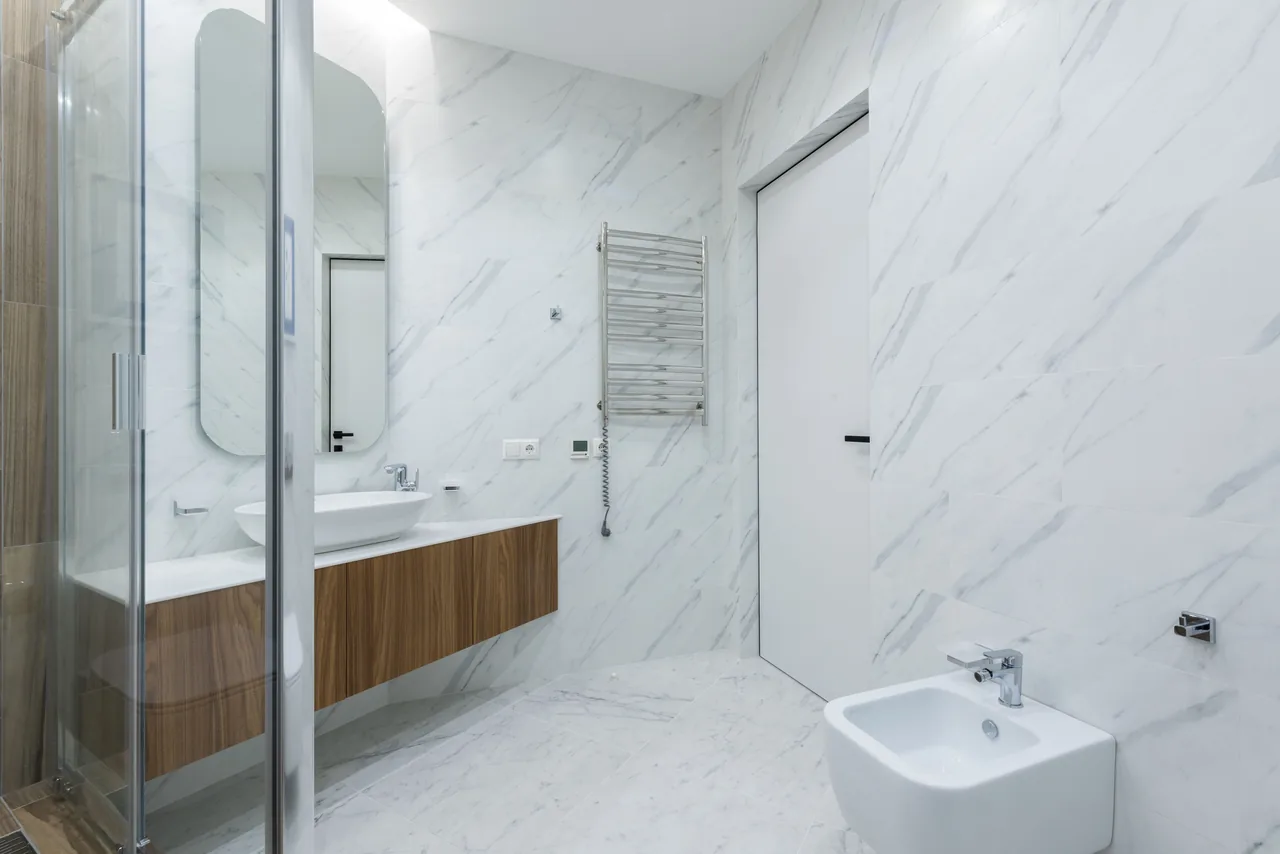
A wall-hung (floating) vanity is generally the better choice in Florida because it lifts the cabinet box clear of a slab that can sweat and clear of any floodwater on a ground floor. A floor-mounted vanity is simpler to install and to support, but its toe-kick lives in the wettest zone of the room. The right pick depends on your wall framing and flood exposure.
Pick by condition
- If you are on a ground floor in a flood-prone or coastal area — choose wall-hung, so the box clears standing water and dries fast.
- If your slab shows any history of moisture or sweating — choose wall-hung and leave the toe space open for airflow.
- If the wall is wood-framed and can take blocking — wall-hung is straightforward to anchor securely.
- If the wall is concrete block (CMU) with no easy blocking — a floor-mounted plywood box on sealed, raised feet is the practical call.
- If you want maximum vanity storage and a heavy stone top — a floor-mounted box carries the load with the least bracing.
Whichever you choose, the box stays plywood; mounting changes how fast it dries, not whether the core can take water in the first place.
Anchoring a wall-hung box safely
A floating vanity transfers its full weight — plus a stone top and a full sink — into the wall, so the anchor matters as much as the cabinet. The right fastening method depends entirely on what the Florida wall is built from.
On wood-framed walls
Solid blocking between studs gives the mounting cleat a continuous bearing surface, the cleanest way to carry a loaded vanity. Where blocking was not pre-installed, the cleat must hit studs directly rather than relying on drywall anchors.
On concrete-block walls
Much of Florida is built in concrete block (CMU), where wall-hung mounting needs sleeve or wedge anchors set into the masonry. When that is impractical, a floor-mounted plywood box on sealed, raised feet delivers most of the drying benefit with far simpler support.
Clearances the layout has to honor
Mounting also interacts with code and ergonomics. The NKBA Bathroom Planning Guidelines recommend 30 inches of clear floor space in front of a vanity, while the FBC-referenced minimum is tighter. A wall-hung box does not change the footprint, but it visually opens a small Florida bathroom and makes the floor easier to clean and dry.
For the full fixture-spacing picture and the rest of the wet-room assembly, our bathroom remodeling team sequences the vanity against the shower, toilet, and the waterproofing layers behind the walls so nothing is boxed in.
Match It to Your Bath
The right vanity specification depends on which Florida bathroom it is going in. A coastal ground-floor bath, a second-floor guest bath, and a powder room face different moisture loads, and the box, mounting, and finish should follow.
- Coastal or flood-prone ground floor: marine-grade plywood box, wall-hung, fully sealed, waterproof top.
- Standard ground-floor primary bath: all-plywood box, wall-hung preferred, MR-MDF doors are fine.
- Second-floor or guest bath: all-plywood box, floor-mounted is acceptable, painted MDF doors.
- Powder room (low water use): all-plywood still preferred, but the moisture stakes are lowest here.
Across every one of these, the pattern holds: plywood for the box, the right finish over it, and mounting matched to flood risk. We build custom plywood cabinetry and install stock and semi-custom vanities to that standard across all 67 Florida counties — see the full cabinet lineup for the box grades we keep on hand.
Frequently Asked Questions
What is the best bathroom vanity material for Florida humidity?
Does MDF swell in a bathroom?
Plywood vs MDF for a vanity — which lasts longer?
Is a solid-wood vanity okay in a humid bathroom?
Should a bathroom vanity be wall-hung or floor-mounted in Florida?
What is the KCMA cabinet certification and does it help in Florida?
References & Sources
- ANSI/KCMA A161.1 — Performance & Construction Standard for Kitchen and Vanity Cabinets. https://kcma.org/certifications/kcma-quality-cabinet-certification
- ANSI A208.1 — Particleboard (Composite Panel Association). https://www.compositepanel.org/education-resources/store/standards/ansi-a2081-particleboard.html
- ANSI A208.2 — Medium Density Fiberboard for Interior Applications. https://web.compositepanel.org/atlas/ecommerce/item/9
- NKBA Bathroom Planning Guidelines with Access Standards. https://media.nkba.org/uploads/2022/05/Bath-Planning-Guidelines.pdf
- Florida Building Code. https://floridabuilding.org/