Watch
Beverage & Wine Fridge Circuit Placement in Florida Kitchens
Does a Beverage or Wine Fridge Need Its Own Circuit?
A built-in beverage or wine fridge does not legally require a fully dedicated circuit, but it should have its own outlet that is kept off the two required 20-amp small-appliance branch circuits. Those two circuits are reserved by code for the kitchen counter receptacles. Putting a cooler on its own individual branch circuit is the cleanest, most reliable way to wire one in a Florida kitchen.
The reasoning is part code and part climate. A wine or beverage cooler is refrigeration equipment — it runs a compressor on a duty cycle, drawing current in waves rather than steadily. In a hot Florida kitchen that compressor cycles harder and more often than it would up north, because the cabinet around it sits warmer and the unit fights a bigger temperature gap. Isolating it on its own circuit keeps that motor load from competing with a toaster and an air fryer on the same wire.
Refrigeration equipment is treated differently
The NEC singles out refrigeration equipment from ordinary plug-in loads. A receptacle that serves a piece of refrigeration equipment is permitted to be supplied from an individual branch circuit rated 15 amperes or greater. That permission is exactly the path a beverage or wine cooler takes when it gets its own line.
Dedicated versus shared, in plain terms
A dedicated circuit serves one outlet and one appliance. A shared circuit serves several. A cooler can technically share a non-counter circuit, but the moment you ask one breaker to carry a cooler plus other loads, you invite nuisance trips when the compressor kicks on. The team that handles your full kitchen remodel will usually pull a separate line during rough-in rather than fight that later.
Can It Go on the Small-Appliance Circuit?
No. A beverage or wine fridge should not share the two required small-appliance branch circuits. NEC 210.52(B)(2) states those two circuits shall have no other outlets
— they exist to power the counter receptacles, and adding a cooler outlet to them is a code conflict, not a convenience.
Florida enforces this through the building code rather than as a stand-alone state rule. FBC Chapter 27 adopts NFPA 70, the National Electrical Code, by reference, so the same Article 210 language that governs a kitchen in any state is what a Florida inspector reads on your job.
Why two 20-amp circuits exist in the first place
NEC 210.11(C)(1) requires two or more 20-amp small-appliance branch circuits for the kitchen, pantry, breakfast, and dining areas. The intent is to keep countertop loads — the coffee maker, the kettle, the blender — from overwhelming a single circuit. Loading a cooler onto one of those defeats the purpose and crowds the very receptacles the rule was written to protect.
The refrigeration carve-out
There is one sanctioned exception. The small-appliance circuits are allowed to serve receptacles for refrigeration equipment, and a refrigeration receptacle is also allowed to sit on its own individual branch circuit. So a cooler may technically tie into a small-appliance circuit as refrigeration — but a separate line is the better build, because it leaves both counter circuits fully available.
| Circuit choice | Code basis | Verdict for a Florida cooler |
|---|---|---|
| Its own individual branch circuit | Refrigeration on a circuit rated 15 A or greater | Best — isolates the compressor load |
| Shared non-counter circuit | Permitted if loads stay within rating | Acceptable, risks nuisance trips |
| One of the two small-appliance circuits | Allowed only as refrigeration; 210.52(B)(2) bars other outlets | Avoid — crowds the counter receptacles |
| Counter receptacle, shared with appliances | Conflicts with 210.52(B)(2) | Not allowed |
The cleanest read of the code, and the one we build to, is the top row: a dedicated line that carries nothing but the cooler. Our breakdown of which kitchen appliances get their own circuit walks through the rest of the panel the same way.
Built-In vs Freestanding Ventilation
For a cabinet installation, the cooler must be a built-in (front-venting) model, not a freestanding one. A built-in unit pushes its compressor heat out the front grille, so it can sit flush inside cabinetry. A freestanding cooler vents from the back or sides and suffocates when it is boxed in — a serious problem in a warm Florida cabinet.
How the two designs move heat
A refrigeration cycle works by absorbing heat from the cabinet interior and rejecting it through a condenser. Where that rejected heat exits decides where the unit can be installed.
- Front-venting (built-in)
- Heat leaves through a grille at the toe of the unit, so cabinetry can close around the sides, top, and back. These are the only coolers rated for an undercounter or island enclosure.
- Rear or side-venting (freestanding)
- Heat leaves out the back or sides, so the unit needs open air around it. Manufacturers typically call for several inches of clearance behind and to the sides — clearance a closed cabinet cannot provide.
The wiring is identical for both designs; the difference is purely whether the body can shed heat where you intend to install it. Confirm the model is front-venting before the cabinet opening is even framed.
Does an Undercounter Fridge Need GFCI?
Yes. In a Florida kitchen, an undercounter beverage or wine fridge needs GFCI protection. The 2020 edition of the NEC expanded 210.8(A) so that all 125-volt through 250-volt receptacles in a dwelling kitchen require GFCI, not only the ones serving countertops or within reach of the sink.
This is one of the most-missed points on a remodel. Older guidance protected only countertop receptacles, so installers sometimes leave a hidden cooler outlet unprotected out of habit. Under the current code as adopted in Florida, the receptacle behind that cooler is just as much a kitchen receptacle as the one on the backsplash — and it must be GFCI-protected.
The nuisance-trip myth
Some homeowners worry a GFCI will trip and spoil the contents of a cooler. Modern compressors and modern GFCI devices coexist well; genuine trips point to a real ground fault worth finding, not a reason to skip protection. Where the receptacle is hidden behind a built-in, set it so the device or its breaker stays accessible for testing and reset.
Protection at the outlet or the breaker
GFCI protection can be delivered two ways, and either satisfies the code.
- GFCI receptacle — the protected device installs at the cooler location; keep it reachable for the monthly test-and-reset.
- GFCI breaker — protection lives at the panel, which suits a hidden receptacle because nothing behind the cabinet needs to be touched.
- Combination AFCI/GFCI — where arc-fault protection also applies, a dual-function breaker covers both in one device.
For a cooler tucked inside an island or a deep cabinet, the breaker-side approach is usually tidiest, since it keeps the only reset button out where a person can actually reach it. Our walkthrough of the Florida kitchen electrical code covers how these protection rules stack across the whole room.
Where the Island Outlet Goes
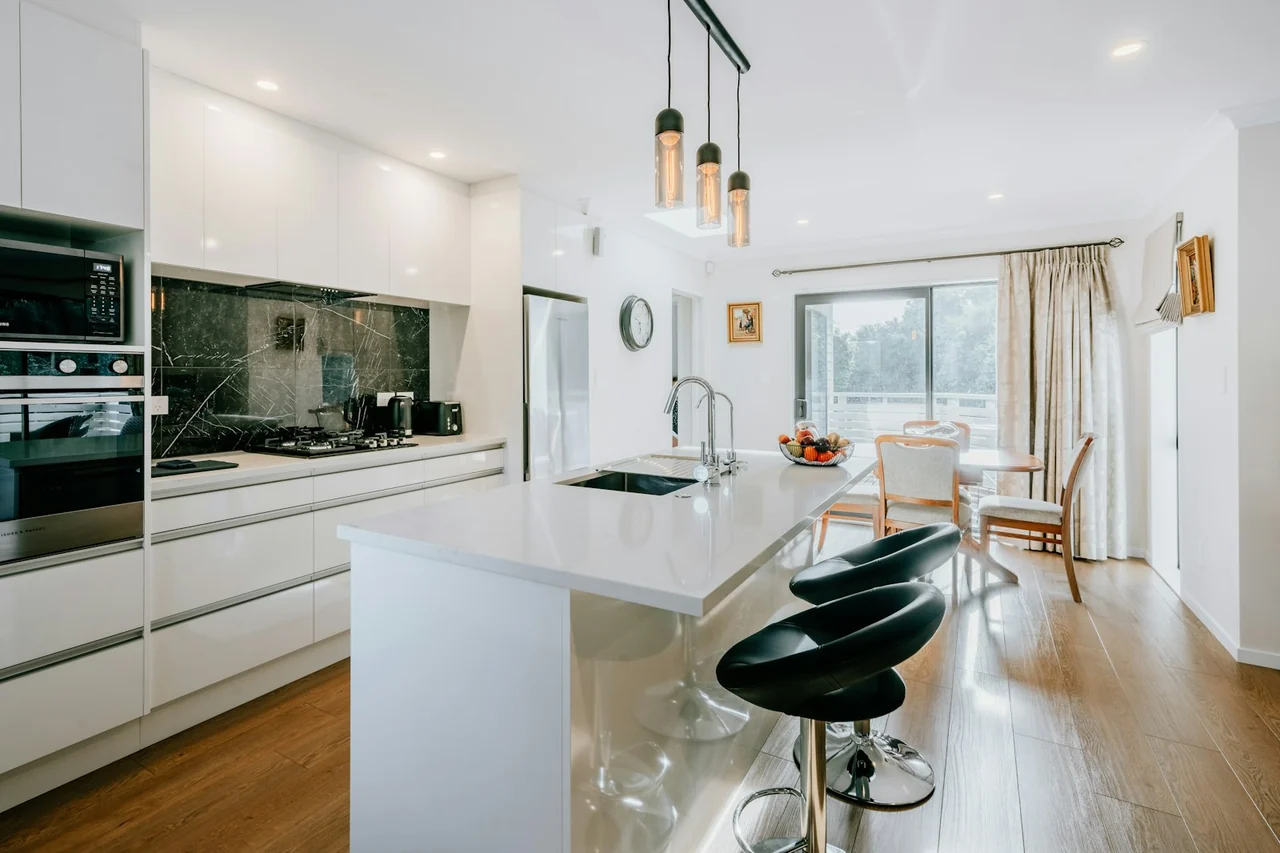
For an island beverage fridge, the receptacle is mounted inside the island cabinet during electrical rough-in, fed by a line run under or through the slab — not tapped from a counter circuit. On Florida slab-on-grade construction, that routing is planned before the slab work and cabinetry are finished, because you cannot easily add it later.
An island is its own wiring problem. There is no wall behind it to fish a cable through, so power reaches it from below. In Florida that means a conduit path cast into or cut through the slab, terminating at a box inside the cabinet where the cooler will plug in. Coordinating that path is a core part of any kitchen island installation.
Plan the receptacle before the cabinet is built
The cooler outlet has to be located, framed, and stubbed during rough-in. Sequence matters on a slab.
- Step1
Set the cooler position
Decide which island bay holds the cooler and confirm the model is front-venting so the surrounding cabinet can be closed.
- Step2
Route the circuit under the slab
During rough-in, run the dedicated line through the slab path to a box inside the island, kept off the two counter circuits.
- Step3
Protect and terminate
Land the receptacle on GFCI protection, position it for the cooler's plug, and leave the reset reachable.
Skip that order and the only fixes left are surface conduit or cutting a finished slab — both avoidable with a little planning. The island's lighting and any seating-side receptacles get sorted in the same rough-in, which is why kitchen lighting and outlets are mapped together.
The Florida Heat Factor
Florida changes the math because a beverage or wine cooler rejects its heat into the cabinet around it, and that cabinet is already warm. The hotter the surrounding air, the harder the compressor works, the longer its duty cycle runs, and the faster a marginal install fails. Front-venting and a clean dedicated circuit are not luxuries here — they are what keep the unit alive.
Why duty cycle climbs in a hot kitchen
A cooler holds its interior at a set point by running the compressor until the temperature drops, then resting. When the cabinet around it is warm, heat leaks back in faster, so the rest periods shrink and the run periods stretch. A unit that loafs along up north can run nearly continuously in a poorly ventilated Florida island — which is precisely why the body must vent from the front.
Several conditions stack in a Florida kitchen to push the compressor harder:
- Warm cabinet air — an enclosed island bay sits well above room temperature, shrinking the cooler's rest periods.
- Blocked rear venting — a freestanding body in a closed cabinet cannot shed heat, so it never fully catches up.
- Door openings — frequent access in a humid room lets warm, moist air in that the unit must re-cool.
- Afternoon solar gain — a kitchen baked by west-facing glass raises ambient temperature around the appliance.
None of these is fixed by upsizing the circuit; they are managed by choosing a front-venting body and giving it air, which is the whole reason built-in models exist.
Heat, humidity, and condensation
Florida's humidity adds a second load. A cooler door opened in humid air pulls moisture inside that the unit then has to manage, and warm cabinet surfaces can sweat. None of this is a wiring issue, but it is why a built-in body with proper front airflow and a correctly sized, isolated circuit matters more in this state than almost anywhere else.
Free In-Home Estimate
Planning a cooler into your island or bar run?
A Pro Work Flooring project director maps the circuit and venting on site and sends a written estimate.
The Placement Checklist
Pulling the rules together, a built-in beverage or wine fridge in a Florida kitchen comes down to a short, ordered set of decisions. Get these right at rough-in and the install is bulletproof.
Wire it in this order
- If it goes inside a cabinet or island — buy a front-venting built-in model, never a freestanding one.
- If you are choosing the circuit — give it its own outlet on a line that is not one of the two small-appliance circuits.
- If the panel allows — run a dedicated individual branch circuit rated 15 amps or greater for the cooler alone.
- If it is any kitchen receptacle — protect it with GFCI under NEC 210.8(A) as adopted in Florida.
- If it lives in an island — set and route the receptacle under the slab during rough-in, before cabinets close.
Follow that sequence and the cooler runs cool, the inspector passes the circuit, and the two counter circuits stay free for the loads they were sized for. We build kitchens to this standard across all 67 Florida counties — start with a full kitchen remodel or fold the cooler into an island installation from the first drawing.
Frequently Asked Questions
Does a wine fridge need its own dedicated circuit in Florida?
Can a beverage fridge go on the kitchen small-appliance circuit?
What is the difference between a built-in and a freestanding wine cooler for ventilation?
Do undercounter beverage and wine fridges need GFCI protection?
Where should the outlet for an island beverage fridge be installed?
Why does a beverage cooler struggle more in a Florida kitchen?
References & Sources
- NFPA 70 — National Electrical Code (Article 210, Branch Circuits). https://www.nfpa.org/codes-and-standards/nfpa-70-standard-development/70
- Florida Building Code, Building — Chapter 27 Electrical (adopts NFPA 70). https://codes.iccsafe.org/content/FLBC2023P1/chapter-27-electrical
- IAEI — Kitchens and Areas for Food or Beverage Preparation and GFCIs (NEC 210.8). https://iaeimagazine.org/electrical-fundamentals/kitchens-and-areas-for-food-or-beverage-preparation-and-gfcis/
- Florida Building Commission — National Electrical Code adoption. https://www.floridabuilding.org/fbc/thecode/NFPA.html