Watch
Kitchen Countertop Outlet & GFCI Code in Florida (2026)
Which Electrical Code Florida Actually Uses
Florida enforces the 2020 edition of the National Electrical Code (NEC, published as NFPA 70), adopted by reference through Chapter 27 of the 8th Edition FBC, in effect since the end of 2023. That single fact changes several answers below, because the newer 2023 NEC is not yet law here.
Most national guides you will find online quote whatever NEC edition their author defaulted to — frequently the 2023 cycle. When the rule in question changed between editions, that mismatch produces advice that is simply wrong for a Florida permit inspection. The kitchen island receptacle is the clearest example, and we return to it below.
Where the rules live in the code book
Kitchen countertop receptacles are governed almost entirely by NEC Article 210, Branch Circuits. The specific sections that decide spacing, height, protection, and circuiting are narrow and worth knowing by number when you talk to an electrician or a plans examiner.
- 210.52(C)
- Receptacle placement at countertops and work surfaces — spacing and the 12-inch threshold.
- 210.52(C)(5)
- Mounting location, including the height ceiling above the counter.
- 210.8(A)
- Ground-fault circuit-interrupter protection for dwelling-unit kitchens.
- 210.11(C)(1) and 210.52(B)
- The two dedicated 20-amp small-appliance branch circuits.
Why the local jurisdiction still matters
The FBC sets the statewide floor, but the authority having jurisdiction — your city or county building department — is who interprets and inspects it. High-velocity hurricane zone counties such as Miami-Dade and Broward layer additional administrative review on top. The receptacle rules themselves do not change county to county, but who signs off, and how strictly, does.
How Far Apart Do Counter Outlets Need to Be?
Under NEC 210.52(C)(1), any kitchen wall countertop space 12 in or wider must have a receptacle, and outlets must be placed so that no point along the counter is more than 24 in from one. In practice that puts receptacles a maximum of about 48 in apart along an uninterrupted run.
The 24-inch figure is a reach distance, not a spacing distance — it is measured from any point on the back edge to the nearest outlet, so a counter section can be 48 in wide and still be covered by an outlet at each end. The code reasons that a small appliance with a roughly 24-inch cord should reach a receptacle from anywhere you set it down.
What does not count toward spacing
Several breaks in the counter reset the measurement or are exempt from needing an outlet directly behind them. Knowing these prevents both over-wiring and a failed inspection.
- Behind the sink and the range. No receptacle is required directly behind a sink, a counter-mounted cooktop, or a range; these interrupt the counter and split it into separate spaces.
- Spaces under 12 in wide. A counter segment narrower than 12 in — a sliver beside a cabinet, for instance — needs no receptacle of its own.
- Corners deeper than 24 in. The blind area in an L-corner past the 24-inch reach is treated as outside the measured wall line.
Each break effectively starts a new counter space, and each new space 12 in or wider re-triggers the requirement for its own outlet. That is why a galley kitchen with a sink and range can need more receptacles than its total length suggests.
How an installer lays it out
A good electrician walks the counter, marks every break, then places outlets so the worst-case reach from any back-edge point stays at or under 24 in. Where a wall outlet cannot land in the backsplash — an all-window wall, for example — NEC 210.52(C)(3) allows it as close as practicable, including an approved in-counter or under-cabinet device. Face-up receptacles set into the countertop surface itself are not permitted.
How High Above the Counter Can an Outlet Be?
A kitchen countertop receptacle may be mounted no more than 20 in above the countertop surface, per NEC 210.52(C)(5). There is no code-set minimum height, but the device must serve the counter and cannot be installed face-up in the work surface, which would let spills and crumbs collect in the slots.
The 20-inch ceiling exists so the outlet stays within easy reach above a standard backsplash without disappearing behind upper cabinets or a range hood. On a typical Florida kitchen with a 36-inch counter height, that puts the usable mounting band roughly between the counter and the bottom of the wall cabinets.
Backsplash height interacts with the rule
A tall tile backsplash or a full-height slab backsplash narrows where the box can sit. Because your countertop fabricator and your electrician are working the same 20-inch band, the outlet locations should be settled before the slab template is cut. Coordinating that early is part of how we approach a new countertop installation so the holes, the splash, and the receptacles all line up.
Why face-up outlets fail inspection
Older kitchens sometimes hid a receptacle face-up in the counter or in a deep blind corner. The current code closes both, because a face-up device collects water and debris directly into the slots — a real hazard in a humid Florida kitchen. Any device must be vertical or otherwise listed for the location.
Do Kitchen Countertop Outlets Need GFCI?
Yes. Every receptacle serving a kitchen countertop in a Florida dwelling requires ground-fault circuit-interrupter protection under NEC 210.8(A). A GFCI is a residual-current device that cuts power within milliseconds when it senses current leaking to ground — the shock hazard that water near a counter creates.
Protection can be delivered two ways, and both satisfy the code. Which one an installer chooses is usually about the count of devices versus the convenience of where you reset a trip.
| Method | How it protects | Trade-off |
|---|---|---|
| GFCI receptacle | The outlet itself senses and trips | Resets at the counter; one device per location |
| GFCI/dual-function breaker | The breaker protects the whole circuit | One device covers many outlets; reset is at the panel |
Either route is compliant, so the deciding factors are how many outlets share the circuit and where the homeowner prefers to reset a trip. In humid, storm-prone Florida, where nuisance trips from moisture are not rare, a counter-level reset is a real convenience.
GFCI versus AFCI — they are not the same
Inspectors increasingly expect kitchen small-appliance circuits to carry both protections, often through a single dual-function device. The two address different hazards, and the code requires each in its own right.
- GFCI guards people against electric shock by detecting current leaking to ground.
- AFCI — the arc-fault circuit-interrupter — guards the building against fires from arcing in damaged wiring.
- Dual-function devices combine both in one breaker or receptacle, which is how many Florida kitchens now meet the rule.
The practical takeaway is that "add a GFCI" is rarely the whole story on a kitchen circuit; arc-fault protection is usually required on the same wiring, and an electrician sizes the device accordingly.
The Two 20-Amp Small-Appliance Circuits
Kitchen countertop receptacles must be fed by at least two dedicated 20-amp small-appliance branch circuits, required by NEC 210.11(C)(1) and assigned by 210.52(B). These circuits serve the counter and eating-area outlets and may not also feed lighting or appliances in other rooms.
Two circuits exist so that a toaster and a microwave on the same counter do not share one 20-amp path and trip it. Spreading alternating outlets across the two circuits is good practice, so a single appliance load never overwhelms one leg.
Which circuit feeds what
- If it serves a countertop receptacle — it must be one of the two 20-amp small-appliance circuits.
- If it is the refrigerator — it may share a small-appliance circuit or sit on its own dedicated circuit, a common Florida choice.
- If it is a dishwasher or disposal — it needs its own dedicated circuit, separate from the small-appliance pair.
- If it is general kitchen lighting — it must be on a separate circuit, never the small-appliance circuits.
That separation is why a kitchen panel schedule lists several distinct kitchen breakers, and why adding a single new counter outlet sometimes means tracing which of the two circuits has capacity to spare.
How many outlets one circuit can carry
The NEC does not cap the number of receptacles on a residential 20-amp small-appliance circuit by a fixed count; it limits the connected load to the circuit rating. In a kitchen, the planning move is to alternate outlets between the two circuits so the heaviest small appliances rarely land on the same leg, rather than to chase a magic number of devices.
An electrician balancing a kitchen will typically split the counter so adjacent outlets sit on opposite circuits, keeping a coffee maker and a toaster from stacking on one breaker. The two-circuit minimum is a floor, not a ceiling — larger Florida kitchens often add a third small-appliance circuit when the counter run and appliance load justify it.
Free In-Home Estimate
Planning new counters and worried about the outlets?
A Pro Work Flooring project director measures the slab and coordinates the receptacle layout with your electrician before fabrication.
Do Florida Islands and Peninsulas Need an Outlet?
In Florida, yes — at least one. Because the state runs the 2020 NEC, a kitchen island or peninsula still requires a receptacle: one for the first 9 sq ft of countertop and one more for each additional 18 sq ft. The 2023 NEC made island outlets optional, but that edition is not law in Florida.
This is the single most common place national advice misleads a Florida homeowner. An article written to the 2023 code will say you can skip the island outlet entirely; follow that here and the work fails inspection. The island rule is the headline reason to confirm the edition before you plan.
Where the island receptacle is allowed to sit
Island and peninsula outlets follow NEC 210.52(C)(3) for location. The device must serve the surface and stay accessible, which rules out the old habit of hiding a receptacle under a deep overhang where a face-up box collects debris.
- In the island base or side, below the counter, where no overhang exceeds the limits for that mounting.
- In an approved pop-up or flush in-counter device rated for the use and installed per its listing.
- Not face-up in the countertop surface, the same prohibition that applies to wall counters.
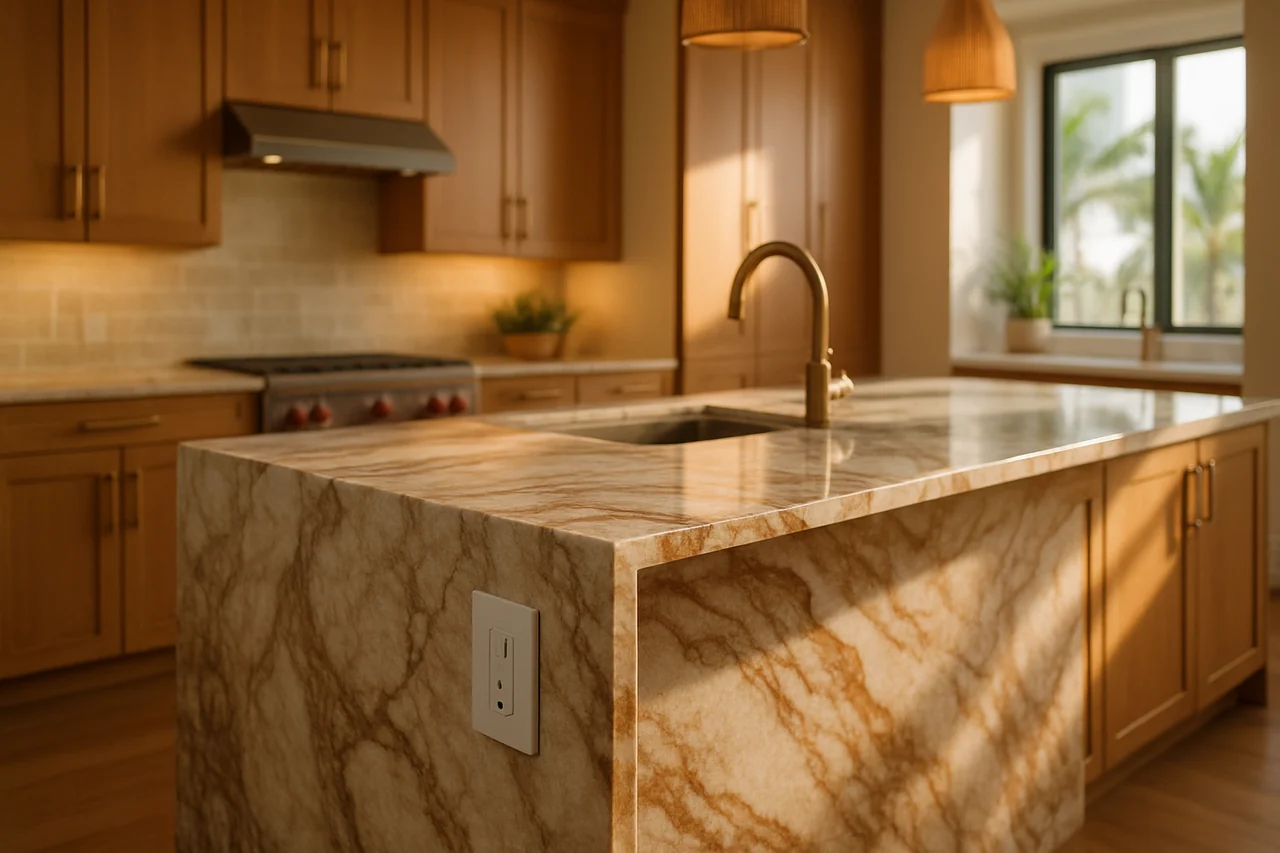
For waterfall-edge or large entertaining islands common in Florida open-plan kitchens, the power has to be routed before the slab sets, which ties the electrical plan to the fabrication and templating schedule. Our breakdown of island wiring on a Florida slab covers how that conduit routes through or under slab-on-grade construction.
When Does a Countertop Remodel Need an Electrical Permit?
A like-for-like countertop replacement that touches no wiring is usually permit-exempt in Florida. The moment the job moves, adds, or rewires a receptacle — or relocates plumbing — it crosses into permitted electrical work under the FBC and Florida Statutes 553.80, and the new work must meet current code.
Permit exemptions in Florida explicitly exclude electrical, plumbing, structural, mechanical, and gas changes. Swapping a slab for a new one of the same footprint is cosmetic; cutting a new outlet into the backsplash to satisfy spacing is electrical work that an exemption does not cover.
Scope that usually stays permit-free
These are the cosmetic moves that typically do not trigger a permit, provided nothing about the wiring or plumbing changes in the process.
- Same-footprint slab swap with the existing sink and outlets reused in place.
- Edge profile or material change on a countertop that keeps the same layout.
- Replacing a single faulty receptacle with an identical one in the same box.
Even on an exempt job, an upgraded counter sometimes reveals outlets that no longer meet spacing or height — at which point bringing them to code becomes permitted work, and worth doing while the counter is off.
Scope that triggers a permit
Once the receptacle layout itself changes, plan on an electrical permit and an inspection against the 2020 NEC.
- Adding an outlet to satisfy the 24-inch spacing on a longer counter.
- Moving an outlet to clear a new sink, range, or backsplash.
- Adding a small-appliance circuit when the existing two are at capacity.
- Relocating the sink, which pulls plumbing and often electrical into scope together.
The reliable rule is simple: change the countertop only and you are usually exempt; change the wiring behind it and you are not. A straight countertop replacement we handle as a finish swap, while anything that relocates power gets coordinated with a licensed electrician who pulls the permit. If you are unsure where your project lands, our Florida kitchen remodel permit guide maps scope to trigger in more detail.
Frequently Asked Questions
How far apart do kitchen counter outlets need to be in Florida?
Do kitchen countertop outlets need GFCI protection?
Do kitchen islands need an outlet by code in Florida?
How high above the counter can a kitchen outlet be?
Does a countertop remodel need an electrical permit in Florida?
Why do kitchen counters need two separate 20-amp circuits?
References & Sources
- NFPA 70, National Electrical Code — Article 210, Branch Circuits. https://www.nfpa.org/codes-and-standards/nfpa-70-standard-development/70
- 2023 Florida Building Code, Building, Eighth Edition — Chapter 27 Electrical. https://codes.iccsafe.org/content/FLBC2023P1/chapter-27-electrical
- Florida Building Code Online — adopted National Electrical Code. https://www.floridabuilding.org/fbc/thecode/NFPA.html
- Florida Statutes 553.80 — Enforcement (building permits). https://www.flsenate.gov/laws/statutes/2023/553.80