Watch
Light vs Dark Countertops for Florida Homes: A Spec Guide
Should Countertops Be Light or Dark?
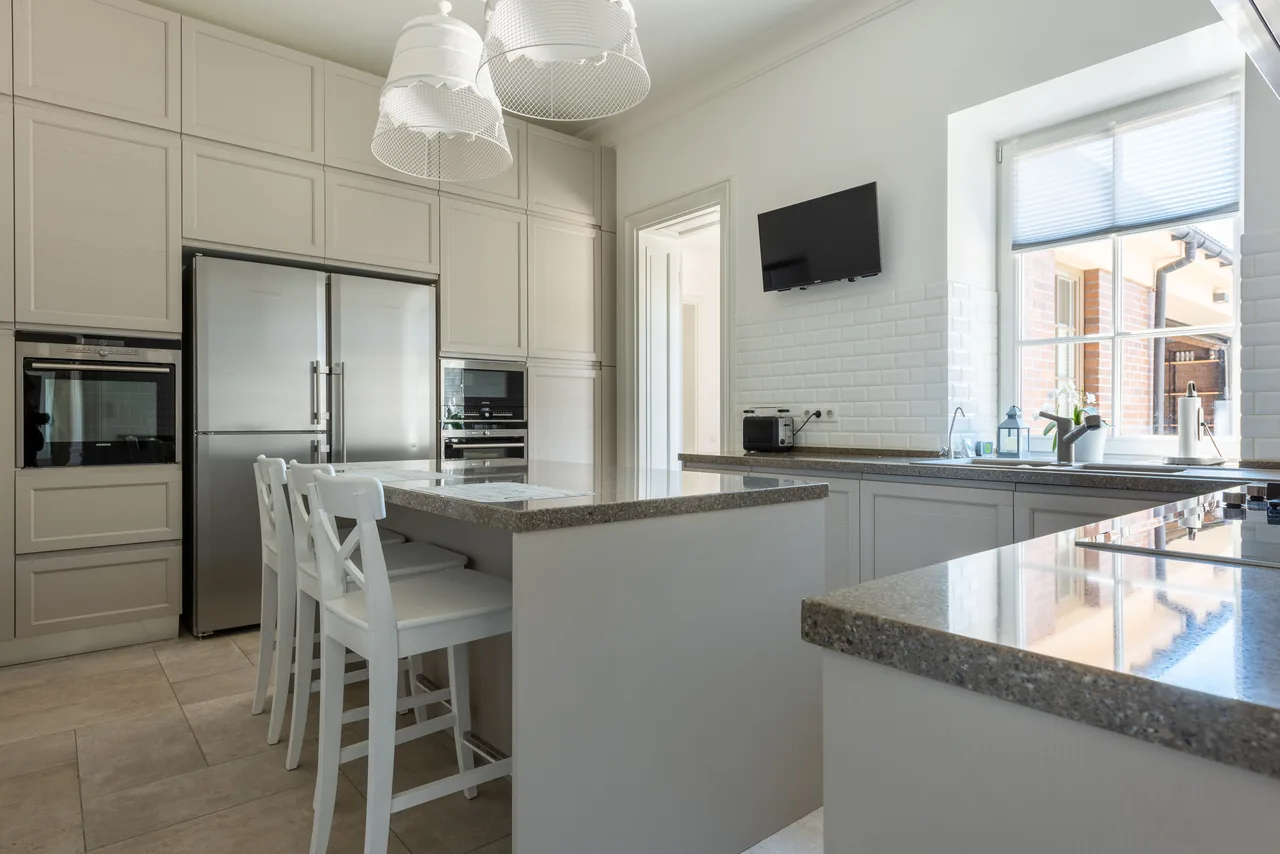
For most Florida kitchens, light countertops are the lower-maintenance choice. The state’s bright, glass-heavy interiors and very hard groundwater work against dark polished surfaces, which show crumbs, fingerprints, water droplets, and the white mineral film that hard water leaves behind. Light tops hide that daily debris but trade it for showing organic stains more readily.
There is no universally correct answer — there is a correct answer for your room. The right way to decide is not a mood board; it is to match the surface’s light behavior to how much daylight floods the space, how the home’s water tests, and how the kitchen actually gets used. A north-facing condo galley and a sun-drenched lanai-adjacent kitchen with twelve-foot sliders are different problems.
What the decision really turns on
Strip away the styling and three measurable variables decide whether light or dark wins in a given Florida kitchen.
- Daylight load. How much natural light enters, and from what angle — raking low-angle sun is the harshest test.
- Water hardness. Whether the home is on hard municipal or well water that leaves white mineral film.
- Use intensity. How heavily the kitchen is cooked in and how often it gets wiped down.
Score those three honestly and the color choice usually makes itself; the rest of this guide is how to read each variable.
LRV — the Spec That Actually Decides
Color is a feeling; light reflectance value is a number. LRV is the percentage of visible light a surface reflects, on a scale where 0% is a theoretical perfect black and 100% is a theoretical perfect white. Picking light versus dark is, in measurable terms, picking high LRV versus low LRV — and that single property drives almost everything a countertop hides or reveals.
How LRV is measured
LRV is read with a sphere-type spectrophotometer under the D65 daylight illuminant — the standardized "average daylight" reference — so the figure describes how a surface behaves in natural light, exactly the condition that dominates a Florida kitchen. It is the same metric architects use to specify paint and wall panels under BS 8493, applied here to stone.
Why high LRV hides debris
A high-LRV surface scatters daylight broadly and evenly, so small foreign objects — a crumb, a fleck of dust, a dried water spot — blend into a bright field instead of standing out against it. The same scattering is why a light top makes a small kitchen read larger and brighter, a real advantage in compact Florida condos.
Why low LRV reveals everything
A low-LRV surface absorbs most of the light that hits it and reflects the rest as a near-mirror, especially when polished. Anything sitting on top — dust, prints, droplets, mineral film — has high contrast against the dark field and catches the eye immediately. The darker and glossier the top, the more it behaves like a display case for daily mess.
Dust, Crumbs, and Hard-Water Film
This is where Florida tilts the decision toward light. Three kinds of light-colored debris — household dust, dry crumbs, and white mineral film from hard water — all show dramatically on a dark top and nearly vanish on a light one. In a state where the tap water is loaded with dissolved limestone, that mineral film is not occasional; it is daily.
Do dark countertops show crumbs and dust?
Yes. Dark countertops show crumbs, dust, and fingerprints far more than light ones, because pale debris has high contrast against a low-LRV surface. A polished black or charcoal top reads as nearly spotless only when freshly wiped; minutes later, settling dust and dry crumbs are visible from across the room under Florida’s strong interior daylight.
Why hard water makes it worse here
Florida’s drinking water is drawn largely from the Floridan Aquifer System, a vast limestone (karst) aquifer that dissolves calcium carbonate into the groundwater. The USGS classifies water above 180 mg/L of calcium carbonate as very hard, and much of Florida sits well past that line. When hard water dries on a counter, it leaves a chalky white CaCO₃ film — invisible on a light top, glaringly obvious on a dark one.
The droplet-spot problem
Every splash near the sink dries to a faint white ring. On light quartz or granite the rings disappear into the pattern; on a dark polished slab they accumulate into a hazy, spotted look that resists casual wiping and needs a deliberate clean. This is the single most common complaint we hear from Florida owners of dark tops.
| What lands on the top | Dark / low LRV | Light / high LRV |
|---|---|---|
| Household dust | Highly visible | Hidden |
| Dry crumbs | Highly visible | Hidden |
| Fingerprints / smudges | Very visible on gloss | Barely visible |
| Hard-water film (white CaCO₃) | Glaring | Masked |
| Coffee / wine / citrus stain | Masked | More visible |
Read that table as a trade, not a winner: dark tops hide dark stains, light tops hide light debris. In hard-water Florida, the everyday mess is overwhelmingly light-colored, which is why light surfaces win the daily-maintenance argument for most homes.
The Honest Downside of Light Tops
Light is not maintenance-free; it just shifts what shows. The debris a light top reveals is organic and dark — coffee, red wine, turmeric, tomato, citrus oils, and the occasional dropped berry. On a pale surface these have high contrast and demand a prompt wipe, where a dark top would have swallowed them.
Do light countertops show stains more?
Light countertops show dark organic staining more than dark tops do, but whether a stain becomes permanent depends on the material, not the color. Non-porous engineered quartz resists absorption and wipes clean; unsealed natural stone can absorb a pigment and hold it. Color governs visibility; porosity governs permanence.
Material matters more than shade for staining
- Quartz (engineered). Non-porous resin matrix; pigments sit on the surface and wipe away, so light quartz is forgiving despite showing more.
- Granite (sealed). A penetrating sealer closes the pores; a sealed light granite resists most kitchen stains if spills are wiped promptly.
- Quartzite (sealed). Dense natural silicate; sealed, it behaves close to granite and holds pale colors well.
- Marble. Reactive to acids; citrus and wine etch the surface regardless of color, a poor fit for a busy Florida kitchen.
The practical move for a light kitchen is to choose a non-porous or properly sealed material, so the surface shows a fresh spill but never keeps it. That pairing — light color, low porosity — is the lowest-effort countertop you can own in this climate.
Which Color Hides Scratches and Wear?
Fine scratches, micro-abrasion, and dull spots read very differently by color and finish. A light, low-gloss surface is the most forgiving of visible wear; a dark, high-gloss surface is the least, because every hairline catches light against the dark field. Color and finish work together here, and finish often matters more than shade.
Gloss is the multiplier
A polished (glossy) top behaves like a mirror, so scratches and swirl marks show as bright lines regardless of color — but the effect is worst on dark gloss. A honed or matte top scatters light and hides fine scratches well. Our breakdown of honed against polished finishes in Florida covers how this interacts with humidity and water spotting.
By material, briefly
Quartz is hard and scratch-resistant but not scratch-proof; granite and quartzite are very hard and rarely scratch in normal use. On any of them, a lighter shade plus a honed finish is the combination that ages most gracefully under Florida’s revealing daylight.
Pick color and finish by condition
- Very bright room, hard water, busy family — light color, low-gloss or honed finish hides dust, film, and scratches.
- Moody, low-daylight space you keep meticulously — dark gloss can work, but plan on frequent wiping for prints and film.
- Worried about dark organic stains — light color in a non-porous quartz or a sealed stone.
- Counters beside large sliders or windows — lean light, and favor UV-stable granite or quartzite over dark resin-heavy quartz.
Use that tree as a filter, not a verdict: it narrows the field fast, and the final pick still comes down to the slab in front of you and the room’s light.
Sun, Glass, and UV Near Sliders
Florida’s defining interior feature — walls of glass — changes the color calculation in two ways: raking daylight exaggerates everything a dark top shows, and prolonged sun raises a real material question for engineered quartz. Both push sun-flooded kitchens toward lighter, UV-stable surfaces.
Raking light is unforgiving
Low-angle morning and evening sun rakes across a countertop almost parallel to its surface, throwing every speck of dust, fingerprint, and water spot into sharp relief. A dark polished top under raking Florida light shows debris that would be invisible at midday. Light, low-gloss tops largely defuse this effect.
UV and the resin question
Engineered quartz is roughly 90–95% crushed stone bound by 5–10% polymer resin, and that resin is not fully UV-stable. Indoor light filtered through glass is usually mild enough that interior quartz is fine, but counters in direct, sustained sun near big sliders carry a fade risk — and a darker, more heavily pigmented resin can show uneven change sooner.
Where granite and quartzite have the edge
Natural granite and quartzite are silicate stones with no polymer binder, so they hold color under sunlight where engineered surfaces can shift. For a top that sees real direct sun — a peninsula against sliders, an indoor-outdoor pass-through — a UV-stable natural stone is the safer specification, and lighter shades still mask the dust that sun reveals.
Simple ways to cut the UV load
If the heart is set on a dark engineered top in a sunny spot, a few measures lower the risk.
- Add solar or low-E glazing. UV-blocking window film and low-emissivity glass cut most of the ultraviolet reaching the slab.
- Soften direct exposure. Shades or a deeper overhang keep peak sun off the surface during the harshest hours.
- Confirm the warranty. Check whether the maker excludes UV or direct-sun damage before committing a dark quartz to a glass wall.
None of these makes resin fully UV-proof, but together they shrink the gap enough that a dark engineered top can survive a bright room.
Resale and the Bright-Room Verdict
Color does not lock in a resale number, but neutrality and brightness travel well. Light, neutral countertops photograph cleanly, make rooms feel larger and airier, and date more slowly than strong dark statements — advantages that matter in Florida’s light-filled, photo-driven housing market.
Do dark or light countertops increase resale value?
Neither color directly raises a home’s value; material quality, condition, and broad appeal drive resale. Light, neutral tops tend to photograph better and suit more buyers, while a bold dark surface can narrow the audience. For resale in Florida’s bright-interior market, a light neutral in a durable material is the safer bet.
The best countertop color for a bright kitchen
For a bright Florida kitchen, a light to mid-tone neutral in a non-porous or sealed material is the lowest-maintenance, most resilient choice: it bounces daylight, masks dust and hard-water film, and resists the raking-light reveal. If a dark anchor is the design goal, confine it to a low-traffic island top while keeping the working perimeter light.
A quick pre-order checklist
Before you sign off on a slab, confirm each of these against the room.
- Daylight checked — you have seen the candidate slab under the kitchen’s real morning and evening light, not just showroom lighting.
- Water accounted for — you know the home’s hardness and have chosen a color that hides, not flaunts, mineral film.
- Finish matched — gloss for drama and easy wiping, honed to hide scratches and spotting.
- Material confirmed UV-appropriate — natural stone for sun-flooded spots, quartz kept out of sustained direct sun.
Clear all four and the top will look right the day it goes in and stay that way through Florida’s brightest afternoons.
Free In-Home Estimate
Not sure which color survives your kitchen’s light?
A Pro Work Flooring project director checks your daylight, tests the water, and sends a written estimate.
However you weigh the trade, the sequence is the same: read the room’s daylight, account for hard water, and match color and finish to how you live. We template, fabricate, and install light and dark engineered quartz and UV-stable natural granite across Florida — see the full countertop lineup for every material and finish, spec-matched to your light.
Frequently Asked Questions
Should countertops be light or dark in a Florida home?
Do dark countertops show crumbs, dust, and fingerprints?
Do light countertops show stains more than dark ones?
Which countertop color hides scratches best?
Why do my dark countertops always look spotted in Florida?
Are dark quartz countertops a problem near big windows or sliders?
References & Sources
- USGS — Hardness of Water (water-hardness classification, mg/L CaCO3). https://www.usgs.gov/special-topics/water-science-school/science/hardness-water
- USGS — Floridan Aquifer System. https://www.usgs.gov/mission-areas/water-resources/science/floridan-aquifer-system
- Light reflectance value — measurement under D65 daylight (BS 8493). https://en.wikipedia.org/wiki/Light_reflectance_value
- U.S. EPA — Secondary Drinking Water Standards (hardness as a secondary, non-health standard). https://www.epa.gov/sdwa/secondary-drinking-water-standards-guidance-nuisance-chemicals