Watch
Tile in Florida: The Complete Guide to Floor, Wall & Shower Tile
Why Tile Rules in Florida
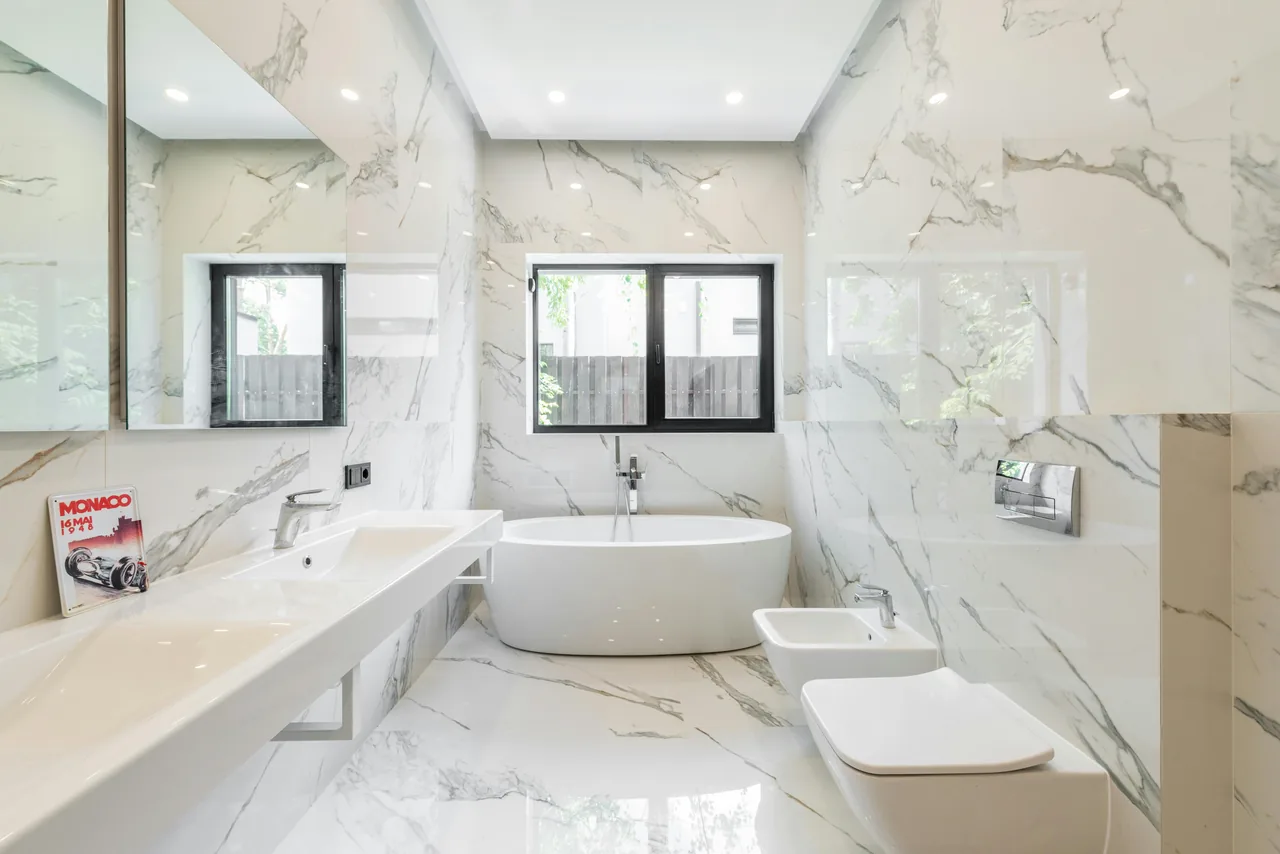
Tile is the default Florida floor because the tile body itself is waterproof — a fired porcelain tile absorbs 0.5% of its weight in water or less, so humidity, spills, and standing floodwater pass over it instead of into it. It also stays cool underfoot in a climate where that matters, and it survives a storm or a burst supply line that would write off carpet, laminate, or solid wood entirely.
That survivability is the Florida argument. After a flood or storm-surge event, a porcelain tile floor on a sound slab can often be cleaned, disinfected, and kept, because neither water nor the contaminants in it penetrate the impervious body; the same square footage in carpet, laminate, or solid wood becomes a demolition line item. In a flood-prone, slab-on-grade state where the concrete sits in direct contact with damp soil, a floor whose body shrugs off moisture is not a luxury — it is the rational default, and it is why so much of Florida is tiled wall to wall on the ground floor.
The cool-underfoot effect is physics, not marketing. A dense porcelain body has high thermal mass and conducts heat away from bare feet, so a tiled slab sits closer to the home's interior temperature than a resilient or wood floor that insulates and traps warmth. In a state where the air-conditioning runs most of the year, that thermal behavior is a daily comfort difference, and it is one more reason tile is the regional default rather than a style choice.
Tile is also the one finish that spans the whole house: the same porcelain line can run from the entry across the kitchen, into the bathroom, up a shower wall, and out onto the lanai floor, with only the abrasion and slip specs changing by location. That continuity is worth planning for — a single tile selection carried through the public rooms reads as a larger, calmer space and removes the transition strips that collect dirt and trip hazards. The rest of this guide is about reading the specs so the tile that goes down is the tile that belongs there.
Porcelain vs Ceramic vs Stone
The three families look similar on a showroom wall but behave differently in a Florida home, and one published number sorts them: water absorption under ANSI A137.1, tested by the ASTM C373 method. Porcelain is impervious; standard ceramic is not; natural stone is porous and chemically reactive.
| Tile family | Water absorption (ANSI A137.1) | Florida behavior | Best Florida use |
|---|---|---|---|
| Porcelain | ≤ 0.5% (impervious) | Body shrugs off humidity, spills, floodwater | Wet areas, whole-home, lanai |
| Ceramic | > 0.5% (semi- to non-vitreous) | Absorbs more; fine where it stays dry | Walls, lower-traffic dry floors |
| Natural stone | Porous and acid-reactive | Reacts to salt air, pool chemicals, acids | Sealed feature areas only |
Read down the absorption column and the Florida ranking is plain: porcelain is the impervious default, ceramic is a dry-area economy choice, and natural stone is a sealed-and-watched material. The detail behind each row matters when a spec sheet lands on the table.
- Porcelain
- Defined by ANSI A137.1 as a tile body with water absorption ≤ 0.5%. Dense, vitrified, and through-bodied or glazed, it is the standard specification for Florida wet areas — bathrooms, showers, lanais — and the safest whole-home choice.
- Ceramic
- A broader category whose bodies absorb more than 0.5% (typically grouped as semi-vitreous to non-vitreous). Excellent and economical for walls and lower-traffic dry floors, but its higher absorption makes it a weaker pick for a Florida shower floor or a flood-prone room.
- Natural stone
- Marble, travertine, and limestone are porous and react to acids, pool chemicals, and salt air. Stone earns its place in Florida only when it is sealed on a schedule and kept out of the harshest wet and coastal exposures.
Within porcelain itself, one more distinction matters for Florida high-traffic: through-body versus glazed. A through-body porcelain carries its color and pattern all the way through the tile, so a chip in a busy entry shows the same tone rather than a pale wound; a glazed porcelain wears its design as a surface layer that is often more decorative but reveals the body if the glaze is breached. For a kitchen, hallway, or entry that takes furniture, sand, and pet traffic, through-body is the more forgiving long-term choice.
Because the absorption number is the dividing line, it is also the number to confirm on a spec sheet before anything else. The full porcelain-versus-ceramic breakdown walks the absorption classes in detail, and the stone-versus-porcelain comparison covers sealing and salt for anyone set on a natural material. For most Florida floors, the porcelain we install is the body that lasts without babysitting.
Reading PEI and DCOF
Two ratings decide whether a floor tile survives its room: how hard its surface is and how much grip it keeps when wet. They are different tests, and a wall tile needs neither — which is why pulling a glossy wall tile onto a wet floor is the most common Florida tile mistake.
The first is the PEI rating, formally the Visible Abrasion Classification under ASTM C1027. A loaded abrasive head is rotated across the glaze until wear becomes visible, and the tile is graded by class.
- PEI Class 1
- Light residential — walls and surfaces with little or no foot traffic.
- PEI Class 2-3
- Residential to heavy residential or light commercial — most Florida home floors land at Class 3.
- PEI Class 4-5
- Commercial to heavy commercial — entries, lanais, and homes with large dogs or sand tracked in from the beach are well served by Class 4 and up.
The second is the DCOF — dynamic coefficient of friction — measured under ANSI A326.3 with an SBR sensor and an SLS wetting solution. The standard states that a hard-surface floor expected to be walked on while wet should have a wet DCOF of ≥ 0.42. In Florida that threshold governs every bathroom floor, kitchen, laundry, lanai, and pool deck, where a higher value is often specified for safety. A DCOF rating is not a guarantee against every slip, but below 0.42 a wet floor is outside the standard for level interior walking surfaces.
Surface texture is the lever that moves the DCOF number. A polished or high-gloss porcelain reads beautifully on a dry floor but typically falls below 0.42 once wet, which is why the same tile body is offered in matte, structured, or grip finishes for wet locations. The selection order, then, runs from location to spec to finish.
- Step1
Name the location and its exposure
Decide whether the surface is a wall, a dry floor, a wet floor, a shower, or a sun-and-salt lanai. The exposure, not the look, sets the minimum specs.
- Step2
Set the abrasion class
Match the PEI class to traffic — Class 3 for general home floors, Class 4 and up for entries, lanais, and pet or sand exposure. Walls can drop to Class 1 to 2.
- Step3
Confirm the wet DCOF and pick the finish
For any floor that gets wet, require a wet DCOF of 0.42 or greater and choose a matte or structured finish that meets it — not the glossiest sample on the rack.
Large-Format and Grout
Large-format tile — anything with one edge of 15 inches or longer, including the 24-by-48-inch panels now common in Florida great rooms — looks seamless but is unforgiving of a wavy slab. The bigger the tile, the flatter the substrate has to be and the more mortar has to sit behind it.
Two install numbers control the outcome, both from the tile standards. Substrate flatness for large-format tile should not vary more than 1/8 in. over 10 ft under ANSI A108, which on a typical Florida slab means a self-leveling underlayment step before any tile is set. Mortar coverage under ANSI A108.5 must reach 80% for interior dry floors and 95% for wet, exterior, and large-format installations — coverage that usually requires back-buttering each tile and a full-coverage trowel. Skip either and the floor lippages at the edges or sounds hollow underfoot within a season.
Grout is the other decision homeowners underrate. The choice runs along a spectrum from cement-based to high-performance.
- 1
Cement grout, sealed
The economical default. It is porous, so in a Florida wet area it must be sealed and re-sealed on a schedule to resist mildew and staining — the upkeep our floor tile crew sizes to the room.
- 2
High-performance grout
Epoxy and modern hybrid grouts are dense and far more stain- and chemical-resistant, which suits showers, pool surrounds, and salt-air exposures where sealed cement struggles.
- 3
Joint width and movement
Rectified large-format tile takes a tighter joint, but the assembly still needs movement accommodation — soft joints at the perimeter and changes of plane — so the field can expand in Florida heat without tenting.
Movement is the detail Florida punishes hardest. A tile field laid over a slab that bakes under a slider or runs from conditioned interior to sun-exposed lanai expands and contracts daily, and a rigid grout joint locked tight to the perimeter has nowhere to go but up. The TCNA Handbook calls for movement joints — flexible sealant rather than grout — at the field perimeter, at columns, and over any structural joint, on a spacing that tightens as the sun exposure increases. Honoring those joints is what separates a floor that lies flat for a decade from one that tents along a wall in its second summer.
Get flatness, coverage, grout, and movement right and a large-format Florida floor reads as one continuous plane; get any of them wrong and the shortcut shows up as a shadow line, a hollow tap, or a tented seam.
Free In-Home Estimate
Not sure which tile holds up in your room?
A Pro Work Flooring project director checks the slab and the slip and abrasion specs on site, then sends a written estimate.
The Waterproofing Behind Wet Tile
Tile is not waterproof — the assembly behind it is. This is the most misunderstood point in Florida tile, and it is where showers fail. Water passes through grout joints and around tile over time, so a wet area needs a bonded waterproof membrane that stops moisture before it reaches the wall behind the tile.
The governing spec is ANSI A118.10, the standard for load-bearing, bonded, waterproof membranes for thin-set tile. Whether the membrane is a trowel-applied liquid or a sheet, the TCNA Handbook shower method (B415) requires it to be continuous — across every change of plane and corner — and to extend without a break from the drain to the full height of the tile. A pan that is waterproof but a wall that is not still rots the framing behind it.
Around a Florida shower the same logic extends outward to the details that actually leak. The curb has to be wrapped on all three faces; the bench needs a slight top slope and a continuous membrane so water sheds rather than pools; and a recessed niche is effectively a small inverted shelf that must be waterproofed at its base and sloped to drain. Each of these is a change of plane, and ANSI A118.10 requires the membrane to carry through every one without interruption.
Florida raises the stakes behind the wall. With high ambient humidity year-round, any moisture that gets past a gap does not dry quickly the way it might in an arid climate — it lingers in the cavity and feeds mold on the framing and substrate. A waterproof pan under a non-waterproof wall, or a membrane stopped short of the tile's full height, is the classic failure: the visible tile looks perfect while the structure behind it degrades. We document the full assembly in the shower waterproofing guide, and our shower tile installation always sets the membrane first and the tile second — never the reverse.
A Florida shower lasts because of the membrane you cannot see, not the tile you can.
ANSI A118.10 / TCNA method B415
The Florida Tile Selector
Pulling it together, every tile decision reduces to one question — where is it going — and that location dictates the required absorption class, abrasion class, slip rating, and whether a membrane is mandatory.
The pattern holds across the house. A wall can take almost any tile because nothing walks on it; a floor adds an abrasion class and a wet DCOF; a shower adds a mandatory membrane on top of both; and a lanai pushes the abrasion class higher because of sun, sand, and the pool deck. The same selector also catches the most expensive mistakes — a glossy wall tile used on a wet floor, a Class 2 tile in a high-traffic entry, or a beautiful but unsealed stone set where pool splash and salt air will etch it within a season.
Whatever the room, the sequence is identical: name the location, set the absorption class, set the abrasion class, confirm the wet DCOF, and decide whether a membrane is mandatory. Do that in order and the tile that goes down is the tile that stays down. For the full menu of bodies, formats, and wet-area assemblies we install statewide, the tile services hub maps each one to the room it belongs in, and the spoke guides above go deep on the three decisions Florida homeowners weigh most.
Frequently Asked Questions
Why is tile the most popular flooring in Florida?
What is the difference between porcelain and ceramic tile in Florida?
What PEI rating do I need for a Florida floor?
What DCOF rating is safe for a wet tile floor in Florida?
Does shower tile make a Florida shower waterproof?
What does large-format tile need that standard tile does not?
References & Sources
- ANSI A137.1 — American National Standard Specifications for Ceramic Tile. https://tcnatile.com/resource-center/ansi-standards/
- ASTM C373 — Standard Test Methods for Water Absorption of Fired Ceramic Tile. https://www.astm.org/c0373-18.html
- ASTM C1027 — Visible Abrasion Resistance of Glazed Ceramic Tile (PEI). https://www.astm.org/c1027-19.html
- ANSI A326.3 — Dynamic Coefficient of Friction (DCOF) of Hard Surface Flooring. https://tcnatile.com/resource-center/dynamic-coefficient-of-friction/
- ANSI A108.5 / A118.10 — Installation and Waterproof Membranes (TCNA Handbook). https://tcnatile.com/resource-center/ansi-standards/