Watch
Natural Stone vs Porcelain Tile in Florida: Sealing & Salt
The Real Difference
The split is mineral, not cosmetic. Porcelain tile is fired clay that vitrifies into a glass-hard, near-zero-porosity body, so it neither absorbs water nor reacts chemically. Natural stone tile — marble, travertine, limestone — is quarried rock with open pores and, in the most popular Florida looks, a calcareous (calcium carbonate) chemistry that acids attack. In a salt-air, pool-deck, daily-humidity climate, that difference decides how much maintenance the floor demands for the next decade.
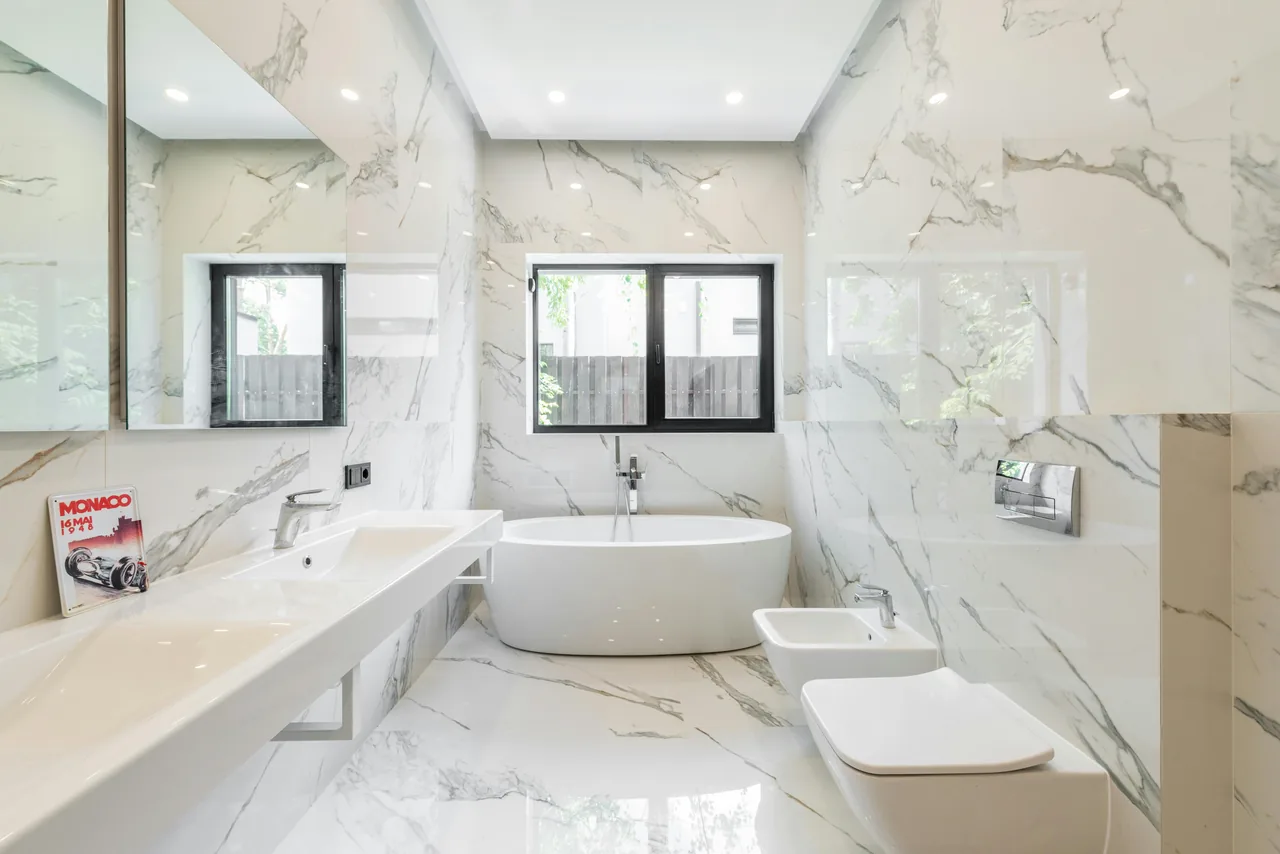
Both can look superb in a Florida home. Honed travertine reads warm and coastal; large-format marble reads luxurious; the porcelain tile we install now mimics either convincingly. The aesthetic gap has narrowed to almost nothing. The behavioral gap has not — and behavior is what a buyer near the water actually lives with.
The single spec that captures it is water absorption, the percentage of its own weight a tile or stone soaks up when saturated. Porcelain sits at the bottom of that scale by definition; stone sits higher, and where exactly a given stone lands tells you whether it will need sealing, how it handles pool overspray, and how forgiving it is of a spilled glass of wine.
Two mineral families explain the rest. Siliceous stones — granite, quartzite — are built from silica and silicates, which are hard and chemically indifferent to household acids. Calcareous stones — marble, travertine, limestone, onyx — are built from calcium carbonate, which is reactive. Almost every stone a Florida buyer is drawn to for the warm, coastal look is calcareous, and that is precisely the chemistry that struggles with pool decks and citrus. Knowing which family a slab belongs to predicts its behavior better than its price tier or its appearance ever will.
The Absorption Ladder
Water absorption ranks these materials cleanly, and the test that produces the number is standardized. For dimension stone it is ASTM C97; for porcelain it is the boil-and-vacuum method behind ANSI A137.1. Lower on the ladder means denser, more stain-resistant, and less needy.
- Porcelain (ANSI A137.1, impervious)
- Water absorption ≤ 0.5%. The vitrified body is effectively non-porous, so it does not stain from below, does not hold salt, and never needs a sealer.
- Granite (siliceous, ASTM C615)
- Class minimum caps absorption near 0.4%. Granite is the most absorption-resistant stone and, being silica-based, shrugs off acids — but it is still stone and benefits from sealing in wet areas.
- Marble (calcareous, ASTM C503)
- Class minimum near 0.20% absorption, denser than most travertine, yet it is calcium carbonate and therefore etches on acid regardless of how low its absorption reads.
- Travertine (calcareous, ASTM C1527)
- Commercial varieties commonly absorb 0.5% to 3% and carry natural voids that are factory-filled. It is the most porous of the four and the most demanding near a Florida pool.
Two ASTM minimums anchor the stone end of this ladder. Marble sold for floors is held to a maximum water absorption near 0.20% under its commodity standard, and granite near 0.4% under its own — figures published in the Natural Stone Institute's Dimension Stone Design Manual, which indexes ASTM minimum requirements by stone type. Travertine carries no such tight ceiling and, with its characteristic open voids (filled at the factory but still present in the body), it is the porous outlier of the group. Those numbers are why a fabricator can tell you, before a single tile ships, roughly how needy a stone will be.
The ladder carries one Florida-specific warning: absorption and acid resistance are different properties. Marble can be denser than travertine and still etch faster, because etching is a chemical reaction with calcite, not a function of porosity. A low absorption number protects against staining and salt; it does nothing against pool acid or citrus. Porcelain is the only material on the ladder that wins on both axes at once — low absorption and full acid indifference — which is the entire reason it became the Florida default.
Salt, Pool, and Acid
This is where Florida separates from the generic tile guide. Three local realities punish porous, calcareous stone that porcelain ignores entirely: airborne salt near the coast, pool-balancing chemistry on the deck, and ordinary acidic spills in the kitchen and bath.
Salt air carries chloride that settles on, and migrates into, open stone pores; as moisture cycles in the daily humidity, salts can crystallize and stress the surface over time. Porcelain, with no meaningful porosity, gives the salt nowhere to go. Pool decks add a second insult — splashed pool water and the muriatic or dry acid used to lower pH are acidic, and on marble or travertine that means dulled, etched patches exactly where bare feet and sun already stress the floor.
Indoors, the culprits are routine. Citrus juice, vinegar-based cleaners, wine, tomato, and many bathroom products are acidic enough to mark calcite stone. The reaction is fast: on calcium-carbonate surfaces, visible etching can begin within roughly 30 seconds of contact, and it is physical damage to the stone, not a stain a mop will lift. Reversing it means professional honing and re-polishing of the affected area — a service call, not a cleaning.
Finish choice changes the stakes. A polished marble or travertine shows every etch as a dull spot against the gloss, so it is the least forgiving surface in an acid-prone Florida kitchen. A honed (matte) finish hides minor etching far better and, as a bonus, raises wet-area slip resistance, which is why honed stone is the sensible specification when a homeowner insists on calcite stone near water. Porcelain sidesteps the entire question: there is no calcite to react, so finish is purely an aesthetic and slip decision, never a durability gamble.
Will this surface forgive a Florida spill?
- Porcelain — inert. Pool acid, salt, citrus, and wine wipe away with no etching and no sealing.
- Granite — siliceous, so acids do not etch it; seal it against staining in wet areas and it handles a pool deck well.
- Marble / travertine — calcite. Acids etch on contact; requires sealing, prompt spill cleanup, and pH-neutral cleaners only.
None of this disqualifies stone. It defines the deal: choose marble or travertine for its look and accept a care routine, or choose porcelain and skip the routine. We install and properly seal marble and travertine across Florida, and we are equally direct with clients about what that surface will ask of them on a pool deck.
The Sealing Commitment
Sealing is the price of admission for natural stone, and porcelain simply does not pay it. The right product is an impregnating sealer (also called a penetrating sealer): it soaks into the pore network and repels liquids from within without leaving a surface film, preserving the stone's natural finish.
Reapplication is periodic, not permanent. Manufacturers of quality water-based impregnators generally cite a service life around 3 to 5 years under normal conditions, but a porous travertine deck taking daily sun, chlorine, and salt spray will need it sooner — often closer to annually in the harshest pool-side exposure. A simple field check tells you when: drop water on the stone, and if it darkens or soaks in rather than beading, it is time to reseal.
Two limits keep expectations honest. First, an impregnating sealer reduces staining and slows salt intrusion; it does not make calcite acid-proof, so etching remains possible and pH-neutral cleaning still matters. Second, the grout joints are their own porous pathway — even with sealed stone, unsealed cement grout wicks moisture and discolors, which is why we pair stone with grout sealing in every humid Florida install.
For homeowners committed to stone, the maintenance reduces to a short, repeatable routine. Run it on a calendar and the floor stays looking the way it did on install day.
- Step1
Test the seal with water
Quarterly, drop a tablespoon of water on the stone and wait a few minutes. If it beads, the seal holds. If the stone darkens or the water soaks in, the impregnating sealer has worn through and the surface is due for resealing.
- Step2
Reseal on schedule
Reapply a quality impregnating sealer roughly every three to five years indoors, and closer to annually for travertine on a chlorinated, salt-exposed pool deck. Clean and fully dry the stone first so the sealer penetrates the pores rather than sitting on dirt.
- Step3
Clean pH-neutral only
Use cleaners formulated for natural stone. Banish vinegar, citrus, bleach, and generic bathroom sprays — all acidic enough to etch calcite regardless of how recently the floor was sealed.
- Step4
Blot acidic spills immediately
Wipe wine, juice, and pool chemistry the moment they land. Because etching can start in seconds, speed protects the surface more than any sealer does.
Free In-Home Estimate
Stone or porcelain for your Florida home?
A Pro Work Flooring project director assesses your slab, your exposure, and your maintenance appetite, then sends a written estimate.
Choosing by Room
Match the material to the exposure and to how much upkeep the household will realistically do. In Florida, exposure is the deciding variable far more than style.
| Location | Porcelain | Natural stone | Florida verdict |
|---|---|---|---|
| Pool deck / lanai | Inert; no sealing; high-DCOF options for wet slip | Travertine reads beautiful but takes acid + salt and needs frequent resealing | Porcelain for low upkeep; honed travertine only if you commit to care |
| Kitchen floor | Acid- and stain-proof; ignores citrus and wine | Marble etches from everyday spills | Porcelain unless the marble look is non-negotiable |
| Bathroom / shower | Low absorption; pairs with waterproof membrane | Stone works if sealed and cleaned pH-neutral | Either; porcelain is the lower-maintenance default |
| Formal entry / feature wall | Large-format mimics stone | Real marble delivers depth porcelain can only imitate | Stone shines in low-acid, low-salt showcase areas |
One more Florida factor tips borderline rooms: the slab and the climate that sit under every install. Stone-look porcelain in large formats now reproduces the veining and movement of marble and the tumbled texture of travertine closely enough that, in a wet or salty room, the practical argument for real stone gets thin. Where stone still earns its place is the dry showcase — a formal foyer, a fireplace surround, a powder room used lightly — exposed to neither pool chemistry nor daily cooking acids, where its depth genuinely outshines any printed surface.
The pattern is consistent: the wetter, saltier, or more acid-prone the room, the stronger the case for porcelain; the more it is a dry, low-traffic showcase, the more a genuine stone earns its keep. If you want the stone look with porcelain behavior, stone-look porcelain is the honest middle path — and the broader tradeoffs across every Florida tile decision live in our complete guide to tile in Florida. For the closely related kitchen-island question, quartzite versus marble follows the same calcite-versus-inert logic, and the absorption framework here maps directly onto the porcelain-versus-ceramic decision within the ceramic family itself.
Frequently Asked Questions
Is natural stone or porcelain tile better for a Florida pool deck?
Does marble or travertine tile need to be sealed in Florida?
Why does marble etch but porcelain does not?
What water absorption rate makes porcelain different from natural stone?
Can I use natural stone tile in a Florida bathroom?
Does salt air damage stone tile near the Florida coast?
References & Sources
- ASTM C97/C97M — Standard Test Methods for Absorption and Bulk Specific Gravity of Dimension Stone. https://store.astm.org/c0097_c0097m-18.html
- ANSI A137.1 — American National Standard Specifications for Ceramic Tile (porcelain impervious, water absorption ≤ 0.5%). https://www.tcnatile.com/products-and-services/ansi-standards/
- Natural Stone Institute — Which ASTM Standards Are Relevant to Natural Stone (Dimension Stone Design Manual). https://www.naturalstoneinstitute.org/designprofessionals/astm/
- Tile Council of North America (TCNA) Handbook for Ceramic, Glass, and Stone Tile Installation. https://www.tcnatile.com/