Watch
Floating vs Freestanding Vanity in Florida: Slab Moisture Decides
The Short Verdict
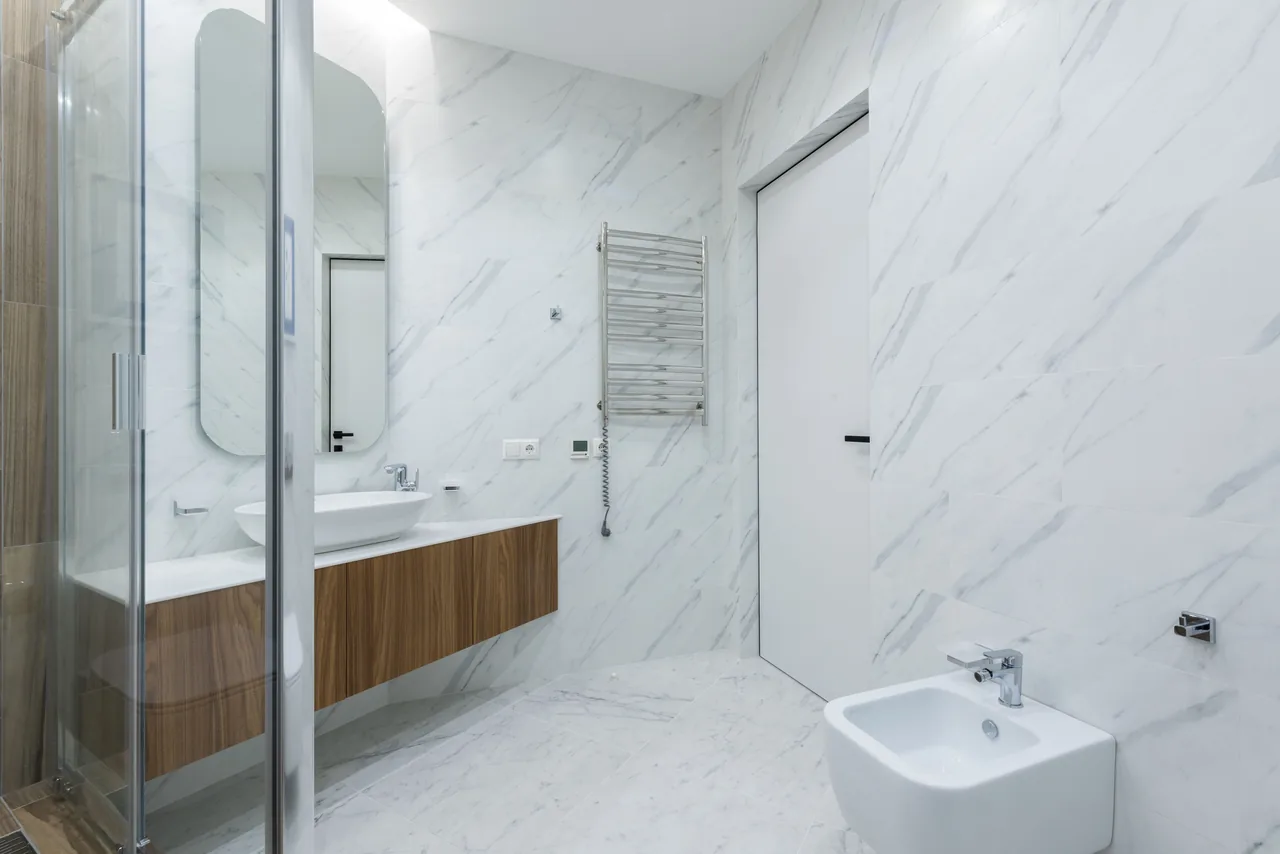
For a Florida slab-on-grade bathroom, a wall-hung vanity is the better moisture decision and a freestanding vanity is the better simplicity decision. Floating the cabinet clears the floor for fast drying after water intrusion; standing it on the slab is easier to install and hides the plumbing. The slab and the wall behind it decide which trade-off you can actually make.
Floating vanity, in one line
A floating vanity bolts to the wall and leaves an open gap beneath the cabinet. That gap is the whole point in Florida: it removes the dark, slow-drying cavity where a freestanding toe-kick traps water and breeds mold.
Freestanding vanity, in one line
A freestanding vanity rests on the floor on a toe-kick base or furniture legs. It needs no structural wall, installs in an afternoon, and conceals supply and drain lines inside the cabinet — but its base lives in the wettest zone of the room.
The trade-off, side by side
- Wall-hung wins on drying. Open floor under the cabinet mops dry and airs out fast after a Florida storm or leak.
- Wall-hung wins on cleaning. Nothing collects dust and standing water in a hidden toe-kick cavity.
- Freestanding wins on install. No blocking, no bracket, no opening the wall — it sets on the slab in an afternoon.
- Freestanding wins on plumbing. Supply and drain lines hide inside the box instead of needing a clean wall rough-in.
The pattern is consistent: floating buys moisture performance, standing buys simplicity, and the Florida slab is what tips most ground-floor baths toward floating.
Why the Slab Decides in Florida
Most Florida homes are built on slab-on-grade construction — a concrete floor poured directly on the ground with no crawlspace under it. That slab stays cool, sits against damp soil, and can sweat where conditioned air meets it, so the floor of a Florida bathroom is a moisture surface, not a dry one.
Ground-floor water intrusion is routine here
Between summer storms, plumbing leaks, and overflow, the ground floor of a Florida home takes on water more often than in a basement-state house. After an intrusion event, the floor under a freestanding vanity is the last place to dry: air can't reach the cavity behind the toe-kick, and standing moisture sits against the cabinet base for days.
What "fast drying" buys you
A wall-hung vanity turns that hidden cavity into open floor. You can mop under it, run a fan across it, and see the slab. Drying the wet zone in hours instead of days is what keeps mold off the framing and the cabinet bottom — the single biggest moisture advantage of floating in this climate.
- Visible slab. You can see a leak or pooled water under a floating vanity before it spreads, instead of discovering it as a swollen toe-kick months later.
- Airflow. A fan or the room's own air movement reaches the slab, so a damp floor dries instead of staying sealed under a cabinet base.
- No wicking edge. With the box lifted off the concrete, there is no particleboard or plywood edge sitting in slab moisture.
Each of those is a direct answer to a Florida failure mode, which is why floating is the default recommendation for any bath that sees water at the floor.
The toe-kick is the wettest 4 inches
On a freestanding cabinet the toe-kick is the strip of box that meets the floor. In a slab bathroom it sits exactly where wicked slab moisture and spilled water collect, so it is the first part of any vanity to swell or delaminate. Sealing that edge and lifting it off the slab are the two defenses, and floating does the second one for free.
What a Floating Vanity Hangs On
A wall-hung vanity transfers its entire weight — cabinet, stone top, sink, and water — into the wall as a downward and outward (tipping) force. It cannot hang on drywall anchors. It needs one of two load paths: continuous in-wall blocking or a rated steel bracket, installed before the wall is closed.
In-wall blocking
Blocking is solid lumber let into the wall behind the finished surface, positioned at the cabinet's mounting height so the hanging screws bite into wood, not a void. On a wood-framed interior wall this is the standard method: a horizontal 2x or plywood backer screwed to the studs across the vanity footprint.
- Blocking
- Solid wood or plywood fixed inside the wall so the vanity's fasteners land in continuous material instead of a single stud or an empty cavity. It must be installed during framing or rough-in, before tile and drywall.
- Steel vanity bracket
- A welded steel support that fastens to studs or masonry and carries the cabinet on a ledger. Bracket systems are how a floating vanity meets a finished wall where no one planned blocking — they bolt through the sheathing into structure.
Plan the support before the tile goes up
The mistake that forces a re-do is closing the wall before deciding the vanity is floating. Blocking and brackets have to be set during rough-in; retrofitting them means opening a tiled wall. We size the support to the cabinet during our vanity installation survey so the blocking is in the wall before waterproofing and tile.
Mounting to a Concrete-Block Wall
Florida exterior walls — and many wet walls — are concrete masonry unit (CMU) block, not wood studs. A floating vanity on a block wall hangs on masonry anchors set into the solid part of the block, because wood-stud screws have nothing to grab and the wrong masonry anchor splits a hollow cell.
Anchor the solid face shell, not the void
A hollow block has a solid outer wall (the face shell) and an empty middle (the core). Anchors have to land in the face shell or a grout-filled cell. A common screw-type masonry anchor needs roughly 1 to 1-3/4 inches of embedment into solid material to hold, so the fastener length is sized to reach past the furring and into the shell.
Why a wedge anchor is the wrong pick
A wedge anchor expands by wedging against solid concrete. Drive one into a hollow core and the thin shell cracks instead of gripping. For block, a sleeve or screw-type masonry anchor in the face shell — or a fully grouted cell — carries a hung cabinet without splitting the unit.
Furring complicates the reach
Florida block walls are usually furred out with strips and drywall, so the anchor crosses an air gap before it reaches block. Either the bracket fastens through furring into the shell with a longer anchor, or solid blocking is set between the furring at the vanity height to give the screws continuous wood. This is judged on site during the master bathroom remodel rough-in.
Weight and Load Limits
The question behind "how much weight can a wall-mounted vanity hold" is really how much the mounting holds, not the cabinet. A frameless wall cabinet body is strong; the limit is the blocking, bracket, and anchors behind it. The published cabinet benchmark is high, but it assumes a correct mount.
What the cabinet standard proves
Under ANSI/KCMA A161.1, the performance standard for kitchen and vanity cabinets, a mounted wall cabinet is gradually loaded to 600 lb with no visible failure of the cabinet or its mounting system, and shelves are held at 15 lb per square foot for seven days. Those numbers describe a properly anchored cabinet — not one on drywall plugs.
The accessible-fixture benchmark
For a fixture a person may lean or sit on, the structural target comes from ICC A117.1 Section 609.8: the supporting structure must take a 250 lb vertical or horizontal force applied at any point without exceeding allowable stresses. It is written for grab bars and seats, but it is the right mental model for how hard a hung vanity's anchors must resist a tipping load.
- Account for the stone top. A quartz or granite vanity top adds substantial dead load above the cabinet — size the blocking and anchors to the finished assembly, not the empty box.
- Add the water and the lean. A filled sink plus someone bracing on the edge is the real-world peak load the mount has to survive, not just the cabinet weight.
- Match anchors to the wall. Stud blocking, steel bracket, or masonry anchor — each has a rated capacity, and the weakest link sets the limit for the whole vanity.
The takeaway is that a floating vanity is as strong as the engineering behind the wall: get the blocking and anchors right and the cabinet's own 600 lb capacity is never the constraint.
The Box Material That Survives Humidity
The best vanity for a humid bathroom is the one whose box does not drink water. In Florida that rules out bare particleboard for the cabinet carcass and the toe-kick. Plywood and clad panels hold up; unsealed particleboard swells and crumbles at the first wet edge, whichever way the vanity is mounted.
Why bare particleboard fails here
Under ANSI A208.1, particleboard is shipped at no more than 10% moisture content and is rated for thickness swell — and the standard notes that essentially no particleboard passes its higher boil-soak water-resistance test. In plain terms, when water reaches an unsealed particleboard edge, the panel swells and stays swelled. A slab toe-kick is exactly that edge.
The materials that hold up
- Marine or exterior-glue plywood. Cross-laminated veneers with waterproof glue resist swelling and hold screws — the strongest box for a floating vanity carrying load on a bracket.
- Thermofoil-clad MDF or panel. A sealed, fused surface keeps moisture off the substrate; durable as long as every edge stays clad and uncut.
- Solid surface or molded composite. Non-porous one-piece bases shrug off standing water and suit wall-hung designs with integrated sinks.
Whatever the carcass, the rule is the same: seal every cut edge and keep the wettest panel out of standing water. Our custom cabinet builds default to plywood boxes for Florida vanities for exactly this reason.
Free In-Home Estimate
Not sure your wall can carry a floating vanity?
A Pro Work Flooring project director checks the wall type, sizes the blocking or masonry anchors on site, and sends a written estimate.
Which Wins, by Bathroom
Matching the mounting to the room is where this decision lands. Wall type, flood exposure, and who uses the bath all push the choice one way or the other.
| Florida bathroom | Better pick | Why |
|---|---|---|
| Ground-floor bath, flood-prone | Wall-hung | Open slab dries fast after intrusion; nothing traps water |
| Exterior CMU wet wall | Either, with masonry anchors | Block wall carries a floating vanity only on face-shell anchors |
| Interior wood-framed wall | Wall-hung | Blocking between studs gives a clean, easy-to-clean float |
| Rental or fast turnaround | Freestanding | No blocking, installs in an afternoon, hides plumbing |
| Wall can't be opened | Freestanding (plywood box) | Avoids retrofitting brackets into finished tile |
A quick decision path
Pick by condition
- If the bath floods or sits on grade — go wall-hung so the floor dries fast and stays moppable.
- If the mounting wall is CMU block — float it only on masonry anchors in the solid face shell, or stand a plywood-box vanity on the slab.
- If the wall is already tiled and closed — choose freestanding to avoid opening the wall for blocking.
- If speed and hidden plumbing matter most — choose freestanding with a sealed plywood or thermofoil box.
Across either path the constant is moisture control: lift the box off the slab when you can, anchor it into something solid when you float it, and never let bare particleboard meet a Florida floor. Bring those three rules to the bathroom remodeling plan and the vanity holds up for the life of the room.
Frequently Asked Questions
Floating vanity vs freestanding — which is better in Florida?
Can a concrete-block wall hold a wall-hung vanity?
Do floating vanities help with cleaning in a humid bathroom?
How much weight can a wall-mounted vanity hold?
What is the best vanity for a humid Florida bathroom?
What blocking does a wall-hung vanity need?
References & Sources
- ANSI/KCMA A161.1 — Performance & Construction Standard for Kitchen and Vanity Cabinets. https://kcma.org/
- ICC A117.1 — Accessible and Usable Buildings and Facilities (Section 609.8 Structural Strength). https://codes.iccsafe.org/content/icca117-12017/chapter-6-plumbing-elements-and-facilities
- ANSI A208.1 — Particleboard (thickness swell and moisture content). https://web.compositepanel.org/atlas/ecommerce/item/1009
- Florida Building Code. https://floridabuilding.org/