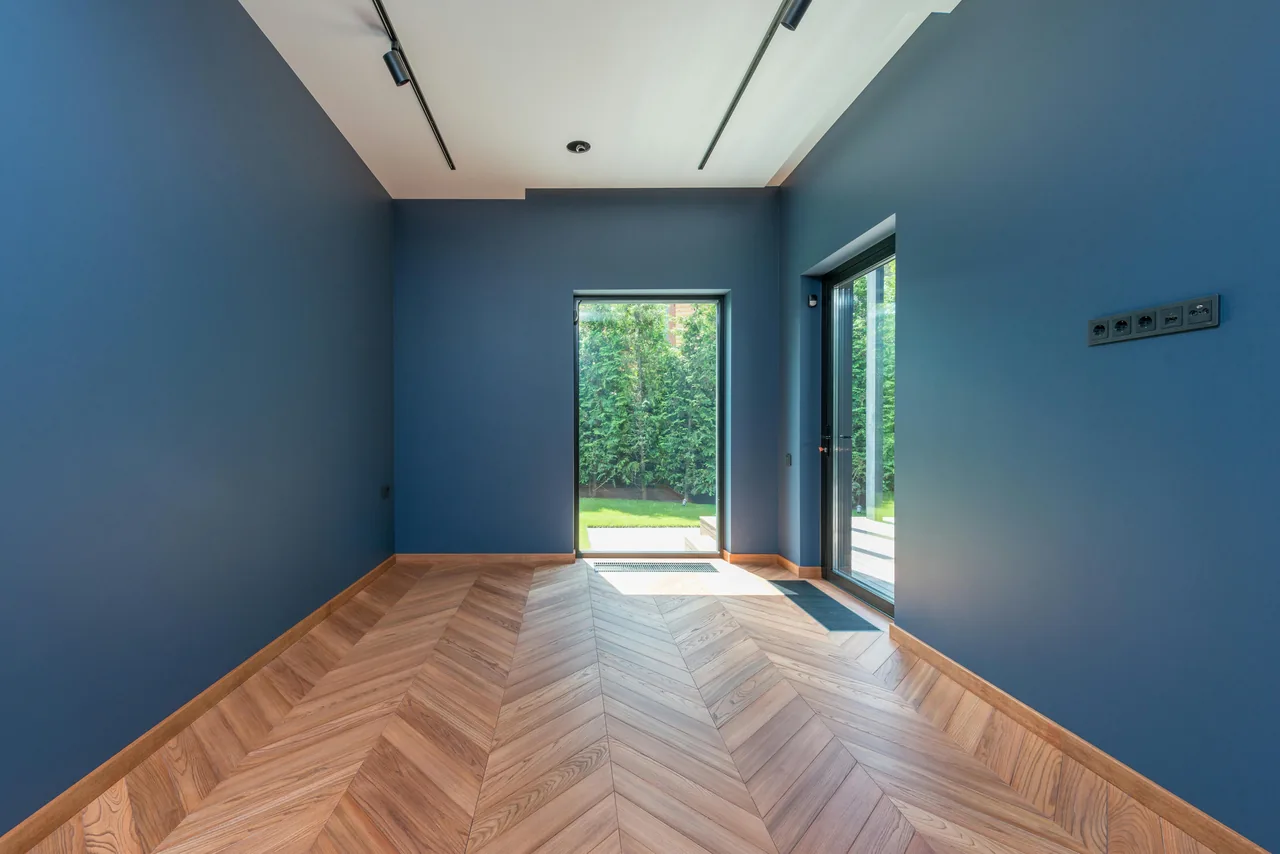
Engineered wood flooring in Florida is the answer to a problem solid hardwood can’t solve here: how to put a real-wood floor on a concrete slab-on-grade that releases vapor year-round, in a climate where indoor humidity swings wide enough to cup solid plank. An engineered board is a genuine hardwood wear layer bonded over a cross-ply core — layers of wood or composite running in alternating directions — and that construction is what keeps it dimensionally stable when a solid board would swell and lift. The numbers that decide an engineered job are the spec, not the sticker: the wear-layer thickness (2 to 6 mm) that sets refinish potential, the core type, and the slab’s MVER reading that dictates the adhesive and barrier.
Watch
See Engineered Wood Flooring Done Right in Florida
What Is Engineered Wood, and Why Does It Win Over Florida Slabs?
Engineered wood is a real-wood floor built to resist humidity movement. Unlike a solid plank milled from one piece, an engineered board layers a hardwood veneer over a stable core, so it expands and contracts far less with the seasonal humidity that defines a Florida home. That stability is exactly why it is the default real-wood choice over slab-on-grade.
- Hardwood wear layer (2–6 mm) — a genuine slice of oak, hickory, maple, or walnut on top; thicker veneers can be sanded and refinished, thin ones cannot
- Cross-ply or HDF core — alternating wood plies or a high-density fiber core that holds the board flat through humidity swings
- Glue-down or floating install — bonded to the slab with a vapor-control adhesive, or floated as click-lock over underlayment
- Prefinished or site-finished — most engineered is factory-finished with a cured, durable topcoat; some thicker products can be site-sanded
- Plank width and species — chosen together, since wider planks and softer species move more and need the stability the core provides
Which Wear Layer Does Your Home Need?
Free in-home visit, slab moisture check, and a wear-layer recommendation matched to your refinish plans and traffic — written estimate, no pressure.
Engineered vs. Solid Hardwood for a Florida Home
Over a slab, engineered wood usually wins on stability; over a wood subfloor, both are on the table. The deciding factor in Florida is almost never looks — a quality engineered floor is indistinguishable from solid once installed — it is how the floor handles slab vapor and humidity.
- Dimensional stability
- Engineered’s cross-ply core resists the cupping and gapping that humidity causes in solid plank. This is the single biggest reason engineered dominates Florida slab installs.
- Subfloor compatibility
- Engineered can glue down or float over concrete; solid hardwood needs nailing to a wood subfloor. Most Florida homes are slab, which tips the choice toward engineered.
- Refinishing
- Solid can be sanded many times; engineered can be refinished only as many times as its veneer allows — once for 3–4 mm, more for 6 mm. If multi-decade refinishing matters and you have a wood subfloor, solid earns its place.
- Moisture tolerance
- Neither is waterproof, but engineered tolerates slab vapor far better. For a real-wood look in a flood-aware ground floor, engineered with a vapor barrier is the safer call — though rigid-core LVP is the truly waterproof option.
Why Florida Engineered Wood Installs Are Different
The slab and the humidity drive every decision. Engineered wood is forgiving compared with solid, but it is still wood, and a Florida install that skips moisture testing or acclimation invites the same gapping and edge-lift that ruins solid floors. Every step of our install manages moisture between the slab, the wood, and the home’s air.
- Slab moisture-vapor emission rate (MVER) and relative-humidity probe testing before glue-down — high readings call for a vapor-control adhesive or a separate barrier
- Acclimation of the engineered planks to the home’s real temperature and humidity so the boards are at equilibrium before they are locked or bonded in
- Vapor-control adhesive or moisture barrier on glue-down installs over slab, matched to the actual moisture reading
- Humidity-conscious expansion gaps at every wall and transition so the floor can move seasonally without peaking — critical in a room that heats up when the AC cycles off
- FBC-aware detailing, with HVHZ-considered assemblies for coastal South Florida projects where applicable, and salt-air-rated transition hardware near the coast
Choosing a Species and Finish for Florida Traffic
Even on an engineered board, the wear layer is real wood, so species hardness still matters. Sand, pets, and traffic test the surface, and a harder species under a durable factory finish holds up best in a busy Florida household.
- White oak — slightly harder than red oak, more water-tolerant, and the most popular Florida engineered surface
- Hickory — among the hardest domestic species, excellent for high-traffic homes with pets and kids
- Hard maple — tight, clean grain that takes a modern light finish well
- European oak — wide-plank looks with wire-brushed and matte finishes that hide everyday wear
- American walnut — rich, dark color; beautiful but softer, so better in lower-traffic rooms
Engineered Wood and Finishes We Install
Core construction and veneer thickness drive Florida longevity more than the brand name. We avoid thin-veneer bargain engineered that cannot be refinished and delaminates when it meets slab moisture.
- Mohawk TecWood engineered
- Shaw engineered hardwood
- Bruce engineered & solid
- Mullican engineered wood
- DuChateau European oak engineered
- Bostik vapor-control wood adhesives
- Bona finishes & sealers
- NWFA installation standards
Will Your Slab Need a Vapor Barrier or Leveling First?
Older Florida slabs are rarely perfectly flat, and some read high on moisture.
We bundle slab prep into the same visit and the same crew — moisture test, grind or patch, self-level, then install — so your project does not bounce between a prep contractor and an installer. Floor Leveling Estimate
Florida Building Code, HVHZ, and Permits for Engineered Wood
A like-for-like engineered wood install over an existing prepared subfloor usually does not require a permit, because it is a floor covering rather than a structural change. The picture changes when the job touches the subfloor structure, the slab, or a moisture assembly — that work can fall under the Florida Building Code, and in High-Velocity Hurricane Zone areas (Miami-Dade, Broward, and other coastal South Florida jurisdictions) certain assemblies carry product-approval requirements.
We tell you during the estimate whether your specific project triggers any FBC or HVHZ requirement, and we document slab and wood moisture readings and install to manufacturer and NWFA standards so the floor performs.
Our 6-Step Engineered Wood Process
Every Pro Work engineered wood project follows the same six-step framework — built around moisture control so a real-wood floor stays flat on a Florida slab.
- Free in-home consultation. We measure, identify the subfloor, and recommend a wear-layer thickness and core for your slab and traffic. You see species and finish options. No commitment.
- Written estimate. Line-item breakdown — wood, vapor-control adhesive or barrier, install labor, transitions, and timeline. Delivered after the visit so you see exactly what you are paying for.
- Slab moisture test. MVER and relative-humidity probe readings on the slab, so the right adhesive and barrier are specified before anything is bonded down.
- Acclimation. Engineered planks rest in the home to reach equilibrium with your interior temperature and humidity — the step that prevents later gapping and peaking.
- Installation. Glue-down with vapor-control adhesive or floating click-lock per the room, with humidity-conscious expansion gaps at every wall and transition. Daily cleanup, single point of contact.
Get a Real-Wood Floor Done Right
Fast reply. Slab moisture-tested. Engineered wood installed to last in Florida, the first time.
How to Identify a Qualified Florida Engineered Wood Installer
The board matters less than the prep beneath it. A quality engineered floor bonded to an untested, unleveled slab will still fail. Verify all of the following before signing anything:
- Slab moisture testing as standard
- A qualified Florida installer tests the slab’s moisture-vapor emission rate before glue-down or barrier decisions. If moisture testing is not in the scope, the install is a guess.
- Acclimates the wood on-site
- Engineered moves less than solid, but it still needs to reach equilibrium with the home’s humidity. An installer who delivers and installs the same day is cutting the step that prevents gapping.
- Specifies wear layer honestly
- A trustworthy installer tells you the veneer thickness and what it means for refinishing — and won’t pass off a sub-millimeter bargain product as a forever floor.
- Slab flatness and leveling included where needed
Florida Engineered Wood Case Study
Our Installation Standards
Every Pro Work engineered wood project meets these installation standards:
- Florida Building Code compliance
- Installed to FBC moisture and assembly requirements, with HVHZ product-approved materials where coastal South Florida requires them.
- Moisture-tested installation
- Slab MVER testing and, where needed, a vapor-control adhesive or barrier before glue-down — the step that prevents the delamination and cupping Florida slabs are known for.
Why Florida Homeowners Choose Pro Work for Engineered Wood
Most crews install the board you point at. We start with the slab and the humidity, then match the wood and the method to what your home can actually support. The same installer who recommends your wear layer also meters the slab, acclimates the wood, and details for seasonal movement — so your real-wood floor stays flat.
- Spec’d to your slab. We match wear layer, core, and install method to your moisture reading and traffic — not a one-size product.
- Slab moisture-tested every job. The most-skipped step in Florida wood installs, and the one that causes the most failures.
- Honest wear-layer advice. We tell you the veneer thickness and what it means for refinishing before you buy.
- One crew, prep to finish. Moisture test, leveling, and install under one schedule — no bouncing between contractors.
Related Flooring Work We Coordinate
An engineered wood project in Florida often pairs with prep and finishing work. We hold it all under one crew so the floor goes down dry, flat, and finished:
- Floor Leveling — self-leveling underlayment so the slab meets the engineered flatness spec before install.
- Subfloor Repair — slab and wood-subfloor moisture and rot correction before the new floor goes down.
- Stair Installation — matching engineered stair treads and risers tied into the new floor.
- Baseboard Installation — trim to finish the perimeter over the expansion gap.