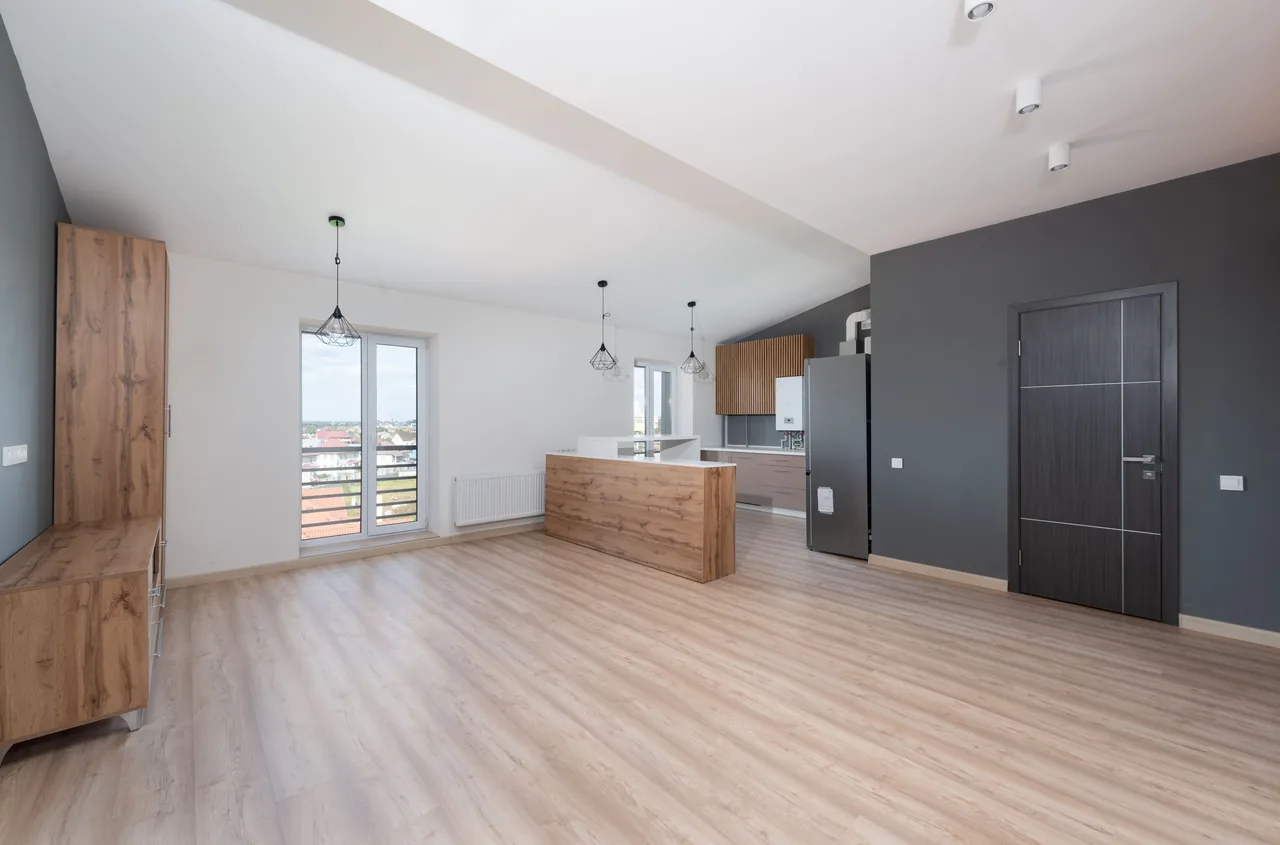
Vinyl flooring installation in Florida covers two fully waterproof formats — sheet vinyl in wide rolls and vinyl tile or plank in individual pieces — and both are a natural fit for a climate where water is a when, not an if. Unlike wood or laminate, vinyl does not absorb water, swell, or grow mold, and sheet vinyl’s continuous surface, with heat-welded or sealed seams, gives moisture almost nowhere to get in. That makes it one of the strongest choices for Florida bathrooms, laundries, and flood-prone ground floors. The numbers that decide a vinyl job are the spec, not the price: 100% waterproof construction, the wear-layer thickness in mils (12 to 28) that sets how long it lasts under traffic, and a glass-smooth slab so the flexible surface does not telegraph imperfections.
Watch
See Vinyl Flooring Installation Done Right in Florida
What Is Vinyl Flooring, and Why Does It Win in Florida?
Vinyl flooring is a 100% waterproof resilient floor that comes in two forms, both built to survive the moisture that destroys other Florida floors. Sheet vinyl rolls out as a near-seamless surface; vinyl tile and plank install as individual pieces. Either way, the material is impervious to water.
- Sheet vinyl — wide rolls glued in a full spread for a near-seamless, water-tight surface; the most moisture-resistant format for wet rooms
- Vinyl tile & plank — individual stone- or wood-look pieces, glued or self-adhesive, with easy single-piece repairs
- Wear layer 12–28 mil — the clear top coat that takes the abuse; thicker means longer life under sand, pets, and traffic
- Felt or fiberglass backing — adds dimensional stability and a measure of comfort underfoot on sheet goods
- Heat-welded or sealed seams — in wet rooms, seams are welded or sealed so the surface is effectively continuous and water cannot migrate below
Sheet or Tile — and Which Wear Layer?
Free in-home visit, slab moisture check, and a sheet-vs-tile and wear-layer recommendation matched to your rooms — written estimate, no pressure.
Sheet Vinyl vs. Vinyl Tile: Which One for Your Room?
Both are waterproof; the format decides water-tightness and repairability. The right call depends on how wet the room gets and how you want to handle future repairs.
- Sheet vinyl — maximum water-tightness
- The continuous surface with welded seams is the most water-tight option, ideal for bathrooms, laundries, and flood-prone ground floors where you want the fewest possible joints.
- Vinyl tile & plank — easy repairs
- Individual pieces let a damaged tile be swapped without redoing the floor, and they deliver crisp stone- and wood-looks. Still waterproof, with more seams than sheet.
- Glue-down vs. self-adhesive
- Full-spread adhesive gives the most durable, water-resistant bond; peel-and-stick suits smaller, lighter-use areas. We spec the adhesive to the room and the slab.
- Where rigid-core LVP fits instead
- If you want a click-together floating plank that hides slab imperfections, rigid-core LVP is the better tool — and we install that too. For the most water-tight glued surface, sheet vinyl wins.
Why Florida Vinyl Installs Are Different
The slab is the whole game, and smoothness is half of it. Most Florida homes are slab-on-grade — concrete poured on the ground — and that slab both releases vapor and shows every imperfection through flexible vinyl. The right install accounts for moisture and delivers a glass-smooth substrate.
- Slab moisture-vapor emission rate (MVER) checked before a full-spread glue-down — high readings call for a moisture barrier or a moisture-control adhesive
- Substrate smoothing so the slab is glass-flat, because flexible vinyl conforms to and telegraphs every pebble, ridge, and dip beneath it
- Heat-welded or sealed seams in wet rooms so the surface is effectively continuous and water cannot reach the slab
- Slab flatness corrected with self-leveling underlayment and skim coats where the tolerance exceeds the manufacturer’s spec
- FBC-aware detailing, with HVHZ-considered materials for coastal and South Florida projects where applicable
Vinyl Flooring Brands We Install
Wear-layer thickness and seam quality drive long-term performance more than the look. Unbranded big-box stock often carries a thin wear layer that shows traffic paths within a year.
- Armstrong sheet & tile vinyl
- Mannington sheet vinyl & Adura tile
- Tarkett commercial & residential sheet
- Congoleum resilient sheet vinyl
- Karndean luxury vinyl tile (glue-down)
- Forbo sheet flooring
- Bostik / Mapei moisture-control adhesives
- Schluter transitions & movement profiles
Will Your Slab Need Smoothing, Leveling, or a Moisture Barrier First?
Flexible vinyl is the least forgiving floor for an uneven slab, and many older Florida slabs are neither flat nor consistently dry. Skim coats and self-leveling underlayment bring the slab to a glass-smooth, flat substrate, and a moisture barrier or moisture-control adhesive handles a slab that tests high.
We bundle slab prep into the same visit and the same crew — moisture test, grind, patch, skim, then install — so your project does not bounce between a prep contractor and an installer. Floor Leveling Estimate
Florida Building Code, HVHZ, and Permits for Vinyl
A like-for-like vinyl install over an existing floor usually does not require a permit, because it is a floor covering rather than a structural change. The picture changes when the job touches the subfloor, the slab, or a moisture assembly — that work can fall under the Florida Building Code, and in High-Velocity Hurricane Zone areas (Miami-Dade, Broward, and other coastal South Florida jurisdictions) certain assemblies and materials carry product-approval requirements.
We tell you during the estimate whether your specific project triggers any FBC or HVHZ requirement, and we detail the install — substrate prep, seams, transitions, and perimeter — to the manufacturer’s specification.
Our 6-Step Vinyl Flooring Process
- Free in-home consultation. We measure, check the existing floor, and recommend sheet or tile plus a wear-layer thickness for your traffic. You see waterproof options matched to your rooms. No commitment.
- Written estimate. Line-item breakdown — vinyl, slab prep, install labor, transitions, and timeline. Delivered after the visit so you see exactly what you are paying for.
- Slab moisture test & prep. MVER check, then grinding, patching, or self-leveling. Moisture barrier or moisture-control adhesive added where the slab tests high.
- Substrate smoothing. The slab is skimmed to a glass-flat finish, because flexible vinyl telegraphs every imperfection beneath it.
- Installation. Full-spread adhesive for sheet or the specified set for tile, with heat-welded or sealed seams in wet rooms for a continuous waterproof surface. Daily cleanup, single point of contact.
Skip the Big-Box Install Gamble
Fast reply. Slab moisture-tested. Waterproof vinyl done right, the first time.
How to Identify a Qualified Florida Vinyl Installer
Vinyl shows its installer’s work more than almost any floor — every skipped prep step telegraphs through the surface. Verify all of the following before signing anything:
- Tests slab moisture before glue-down
- A qualified Florida installer tests the slab’s moisture-vapor emission rate before a full-spread bond. If moisture testing is not in the scope, the adhesive can fail and the floor can lift.
- Smooths the slab to glass-flat
- Flexible vinyl telegraphs every bump. An installer who lays vinyl over a rough slab is guaranteeing visible imperfections and faster wear at high spots.
- Heat-welds or seals seams in wet rooms
- For bathrooms and laundries, welded or sealed seams keep the surface continuous and water-tight. Ask how seams are handled in wet areas.
- Recommends the right wear-layer mils honestly
- A trustworthy installer specs a thicker wear layer for busy entries and kitchens rather than selling the thinnest goods to win on price.
- Written line-item estimate after a site visit
- A reputable installer measures on-site, checks the subfloor, and itemizes vinyl, prep, and labor. A phone quote with no slab inspection is a red flag.
Florida Vinyl Flooring Case Study
Our Installation Standards
Every Pro Work vinyl flooring project meets these installation standards:
- Florida Building Code compliance
- Installed to FBC moisture and assembly requirements, with HVHZ product-approved materials where coastal South Florida requires them.
- Moisture-tested installation
- Slab MVER testing and, where needed, a moisture barrier before a full-spread glue-down — the step that prevents the adhesive failure and lifting Florida slabs are known for.
Why Florida Homeowners Choose Pro Work for Vinyl
Most crews roll out vinyl over whatever slab they find. We treat the slab and the seams as the project. The same installer who recommends sheet or tile also tests the slab, smooths it glass-flat, and welds the seams in wet rooms — so the waterproof floor you paid for actually performs.
- Spec’d to your traffic. We match the wear-layer mils to entries, kitchens, and rentals — not the thinnest big-box goods.
- Slab moisture-tested every job. The most-skipped step before a glue-down, and the one that causes lifting.
- Glass-smooth substrate. We prep so imperfections never telegraph through the surface.
- Welded seams in wet rooms. A continuous, water-tight surface for baths, laundries, and flood-prone floors.
Related Flooring Work We Coordinate
A vinyl project in Florida often pairs with prep and finishing work. We hold it all under one crew so the floor goes down flat, waterproof, and finished:
- Floor Leveling — self-leveling underlayment and skim coats so the slab is glass-flat before vinyl.
- Subfloor Repair — slab and vapor correction after moisture or flooding, done before the new floor.
- Floor Repair — patching and resurfacing of a damaged existing floor or substrate.
- Baseboard Installation — PVC or moisture-resistant baseboard to finish the perimeter.