Watch
Porcelain vs Marble Flooring for Florida Homes: A Spec Breakdown
The Short Verdict
On a Florida floor, porcelain wins almost everywhere it matters. It is roughly twice as hard as marble on the Mohs scale, it absorbs almost no water, it never needs sealing, and it does not chemically react with pool water or acidic spills. Marble is a beautiful, soft, porous stone that asks for protection a humid, pool-centric state rarely lets it keep.
That does not make marble wrong — it makes it a finish for the right room and the right owner. The honest framing is not "which is better" but "what does each cost you over ten years on a slab near a pool?" Five specs settle that question, and porcelain leads on all five.
- Hardness: porcelain Mohs 7-8 versus marble 3-5 — scratch and dulling resistance against tracked-in sand.
- Water absorption: porcelain ≤ 0.5% versus porous calcite — whether the floor needs sealing at all.
- Wet slip: selectable porcelain DCOF versus slick polished marble — pool-entry safety.
- Acid resistance: inert porcelain versus etch-prone calcite — survival of pool chemistry and citrus.
- Upkeep: wipe-clean porcelain versus a multi-step marble seal-and-refinish routine.
The sections below take those five in the order a Florida buyer should weigh them, starting with the hardness gap that drives the rest.
What Each One Actually Is
The performance gap starts with what these materials are at the molecular level. One is a manufactured ceramic fired past vitrification; the other is a natural stone made mostly of a single, acid-sensitive mineral. Everything downstream follows from that.
Porcelain tile, defined
Porcelain tile is a clay-based ceramic fired at very high temperature until the body vitrifies — the particles fuse into a dense, glass-hard mass. Under ANSI A137.1, a tile only earns the name "porcelain" when its water absorption is 0.5% or less, the impervious class. Color can run through the entire body (through-body porcelain) or sit in a fired glaze.
Marble, defined
Marble is a metamorphic rock formed when limestone recrystallizes under heat and pressure. It is composed predominantly of calcium carbonate (CaCO₃) in the form of calcite. That single fact — calcite is soft and acid-soluble — drives marble’s hardness, its porosity, and its tendency to etch. The veining buyers love is mineral impurity threaded through the calcite.
Why the chemistry decides the floor
Porcelain’s vitrified body is chemically inert and physically hard. Marble’s calcite body is reactive and comparatively soft. A Florida floor lives in sand, sun, humidity, and chlorinated water, so the material that is both harder and inert simply has fewer ways to fail.
Hardness: the Mohs Gap
Hardness predicts how a floor handles the grit every Florida household tracks in from driveways, beaches, and pool decks. On the Mohs scale, fired porcelain rates about 7-8 while marble sits at roughly 3-5 — a gap wide enough to change daily life.
What the numbers mean underfoot
Quartz sand, the most common abrasive in a coastal home, sits near Mohs 7. That means sand can scratch and slowly dull a marble floor (softer than the sand) but struggles to mark porcelain (as hard or harder). On a high-traffic Florida entry, the difference shows within a season.
- Porcelain (Mohs 7-8): resists scratching from tracked-in sand and grit; keeps its finish in entries, kitchens, and pool-adjacent rooms.
- Marble (Mohs 3-5): softer than common floor grit, so traffic lanes lose sheen and show micro-scratches over time.
- Limestone and travertine (Mohs 3-4): close cousins of marble, softer still, and even more abrasion-sensitive.
Hardness is not the only story — a hard floor can still crack over a moving slab — but for surface wear, the Mohs gap is the single most predictive spec, and it favors porcelain on any floor that sees real traffic.
Absorption and the Seal Cycle
Water absorption is the spec that separates a maintenance-free floor from a recurring chore. Porcelain absorbs 0.5% or less by weight; marble is porous calcite that wicks water, oil, and dissolved minerals into its body unless a sealer slows it down.
How absorption is measured
The number comes from ASTM C373: a dried tile is boiled in water, then weighed saturated, and the weight gain becomes the absorption percentage. ANSI A137.1 uses that result to classify tile, with porcelain as the impervious tier at ≤ 0.5%. Marble has no comparable ceiling because it is quarried stone, not a manufactured body.
What porosity costs in Florida
In a state where indoor relative humidity stays high and pool splash is routine, a porous floor is a liability. Marble must be sealed with an impregnating sealer that bonds inside the pore structure to repel liquids — and that protection wears off. Most marble floors need resealing every 1 to 3 years, sooner in high-traffic or high-moisture rooms. A simple water-drop test tells you when: if a drop darkens the stone within minutes, the seal has failed.
- Porcelain sealing
- None required. The vitrified body cannot absorb water, so only cement-based grout joints may want a sealer — the tile itself never does.
- Marble sealing
- Periodic impregnating sealer, typically every 1-3 years, verified by the water-drop test. The sealer reduces staining; it does not harden the surface or stop etching.
Wet Slip Near the Pool
In a pool-centric state, wet traction is a safety spec, not a preference. Polished marble becomes glass-slick when wet, and the relevant measure is DCOF — dynamic coefficient of friction — governed by ANSI A326.3.
The numbers that govern wet floors
ANSI A326.3 sets a wet DCOF minimum of 0.42 for level interior areas walked on while wet. For pool decks, walkways, and wet exterior spaces, the standard points higher — to about 0.55 or more — because barefoot, dripping traffic is far less forgiving. A high-gloss polished marble floor rarely meets even the indoor minimum once water is on it.
Pick by where the floor lives
- Pool entry, lanai, or covered patio — specify textured or matte porcelain meeting DCOF ≥ 0.55; skip polished marble entirely.
- Bathroom or laundry floor — use porcelain at DCOF ≥ 0.42, ideally higher for a shower or barefoot wet zone.
- Dry interior living or dining room — either material is defensible; marble’s slip risk drops when the floor stays dry.
The pattern is consistent: the wetter and more barefoot the area, the more decisively porcelain wins, because you can specify a textured porcelain to a published DCOF that a polished stone simply cannot reach.
What to confirm before you specify
For any wet or pool-adjacent Florida floor, three line items belong on the spec sheet before tile is ordered.
- Published wet DCOF: confirm the porcelain’s tested value meets 0.42 indoors or 0.55 for pool decks under ANSI A326.3.
- Surface texture: choose a matte or structured face for wet zones rather than a high-gloss finish that mimics polished stone.
- Slab readiness: verify the slab is moisture-tested and flat enough for the tile format you have selected.
Lock those three down and a porcelain floor clears the safety bar by design — a guarantee polished marble cannot make on a wet pool entry.
Etching and Pool Chemistry
Etching is the failure mode unique to marble, and Florida is full of triggers for it. Because marble is CaCO₃, any acid reacts with the surface and dissolves a microscopic layer, leaving a dull or whitish mark that no sealer prevents.
What etches a Florida marble floor
The acids that cause etching are ordinary in a Florida home. The reaction is chemical, fast, and permanent until the spot is professionally re-honed.
- Pool and spa chemistry: chlorinated and acidified water tracked in on wet feet dulls polished marble over time.
- Citrus and beverages: a dropped lime wedge, orange juice, wine, or soda etches within minutes of contact.
- Cleaning products: many common and "all-purpose" cleaners are acidic enough to etch — only pH-neutral stone cleaners are safe.
- Hard-water and salt-air residue: coastal exposure adds mineral and salt deposits that complicate care on porous stone.
Porcelain is immune to all of this. Its inert, vitrified body shrugs off pool water, citrus, and standard cleaners, which is why it dominates Florida kitchens, baths, and pool-adjacent floors and why the porcelain floor tile we install needs no acid-avoidance routine at all. For the chemistry in depth, see our note on why marble etches and how to repair it.
Free In-Home Estimate
Not sure which holds up in your home?
A Pro Work Flooring project director tests your slab on site, checks the room’s moisture and traffic, and sends a written estimate.
Lifetime Maintenance, Compared
Over ten years on a Florida slab, the two floors diverge sharply in the work they demand. Porcelain asks for routine cleaning; marble asks for a maintenance program. Here is the head-to-head on the specs that decide that gap.
| Spec | Porcelain tile | Marble | Why it matters in Florida |
|---|---|---|---|
| Mohs hardness | 7-8 | 3-5 | Tracked-in sand (~Mohs 7) dulls marble, not porcelain |
| Water absorption (ASTM C373) | ≤ 0.5% | Porous calcite | Humidity and pool splash penetrate unsealed marble |
| Sealing | None (tile body) | Every 1-3 yr | Recurring labor and downtime for marble |
| Acid etching | Immune | Etches on contact | Pool chemistry, citrus, many cleaners mark marble |
| Wet DCOF (A326.3) | Specify ≥ 0.42 / 0.55 | Polished often below | Pool-entry safety favors textured porcelain |
| Repair of dull spots | Not needed | Re-hone / re-polish | Marble needs professional refinishing to restore sheen |
The marble upkeep routine
Keeping a marble floor looking new in Florida is a defined sequence, not a wipe-down. Skipping any step shortens the floor’s good-looking life.
- Step1
Clean pH-neutral only
Use only pH-neutral stone cleaners; acidic and generic cleaners etch the surface on contact.
- Step2
Blot spills immediately
Wipe citrus, wine, and pool-chemical drips at once — etching begins within minutes.
- Step3
Reseal on the water test
Run the water-drop test; reseal with an impregnating sealer when the stone darkens, typically every 1-3 years.
- Step4
Re-hone or re-polish
Have etch marks and traffic dullness professionally re-honed or re-polished as they accumulate.
None of these steps exist for a porcelain floor, which is the practical core of the comparison: marble buys you a look in exchange for an ongoing routine, and porcelain buys you the look-alike with none of it. When a stone floor does need restoring, our floor refinishing service handles the re-honing, and floor repair covers cracked or hollow tile.
Where Marble Still Wins
For all of porcelain’s spec advantages, marble keeps a few that matter to the right owner. Naming them honestly is part of a real comparison.
Genuine depth and uniqueness
No two marble slabs are identical, and light travels into the stone in a way printed porcelain only imitates. In a low-traffic formal space — a dry foyer, a primary suite — that depth is a real luxury cue, and the slip and etch risks fall when the floor stays dry and acid-free.
The premium-finish argument
In Florida’s luxury coastal markets, genuine stone can carry a perceived-value story that porcelain does not, even where a high-end porcelain would perform better. That is a marketing reality worth weighing alongside the engineering.
How to get both
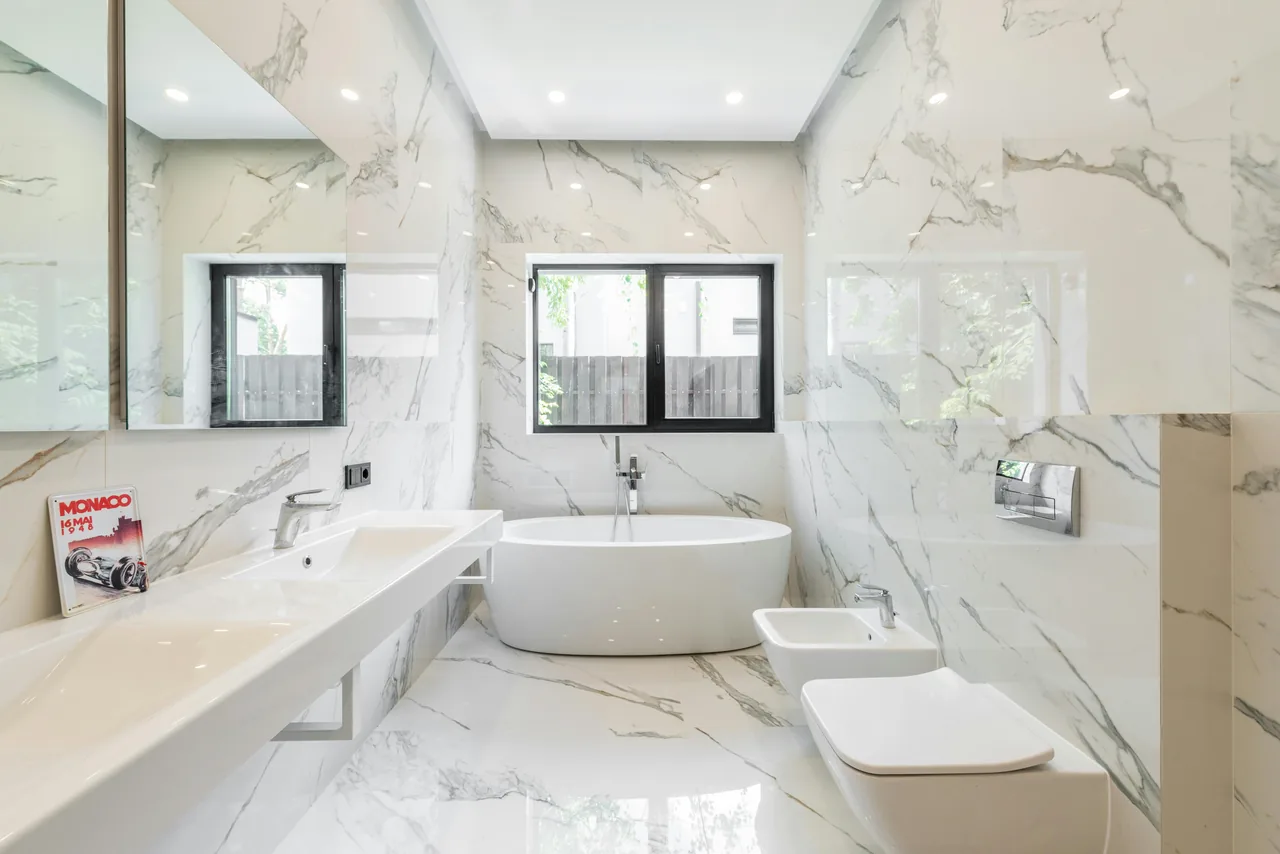
Many Florida homes split the decision: marble (or a marble-look porcelain) in a dry, low-splash showcase room, and impervious porcelain everywhere water, sand, and pool traffic reach. Compare it against the broader options in our natural stone versus porcelain breakdown and the closely related porcelain versus ceramic comparison before you commit a whole floor to one material.
Whatever you choose, the sequence is the same: match the material to the room’s moisture and traffic, confirm the wet DCOF where it counts, and test the slab first. Our crews install both porcelain and natural-stone floors across all 67 Florida counties through our tile flooring installation service.
Frequently Asked Questions
Is porcelain or marble better for floors in Florida?
Is a marble floor slippery when wet near a pool?
Does a marble floor need sealing in Florida?
Why does marble etch but porcelain does not?
Is porcelain harder than marble?
What is the best stone-look floor for a humid Florida climate?
References & Sources
- ANSI A137.1 — American National Standard Specifications for Ceramic Tile (0.5% porcelain absorption). https://www.tcnatile.com/products-and-services/ansi-standards/
- ASTM C373 — Standard Test Methods for Water Absorption, Bulk Density, Apparent Porosity, and Apparent Specific Gravity of Fired Whiteware Products. https://www.astm.org/c0373-18.html
- ANSI A326.3 — Dynamic Coefficient of Friction (DCOF) of Hard Surface Flooring Materials. https://www.tcnatile.com/products-and-services/ansi-standards/
- Tile Council of North America (TCNA) Handbook for Ceramic, Glass, and Stone Tile Installation. https://www.tcnatile.com/
- Florida Building Code. https://floridabuilding.org/